MIT’s SANDO plans drone routes around moving obstacles
MIT’s SANDO plans drone routes around moving obstacles, with a safety guarantee that still needs to hold up on real sensors and flight controls.
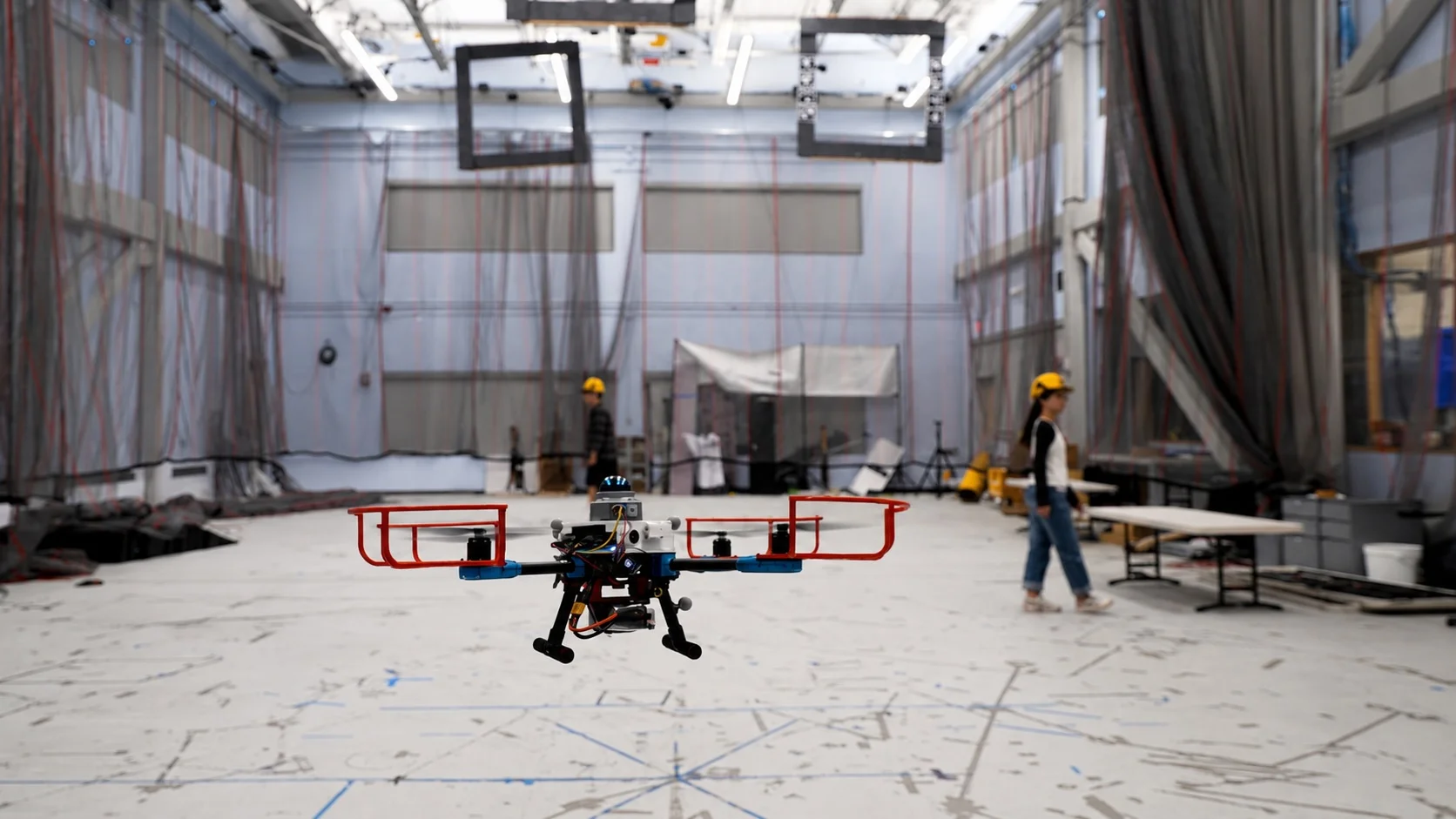
MIT researchers have developed SANDO, a drone planner that builds routes through unmapped spaces while accounting for where moving obstacles could go next. In an October 7 announcement, MIT described a mathematical safety guarantee for each planning window, subject to strict assumptions about obstacle motion, sensing and flight control.
The planner, featured in The Rundown’s October 8 coverage, guided a drone through 12 flights among moving obstacles without a collision, according to MIT. But the authors acknowledge that errors on their test hardware broke the proof’s assumptions, so the formal guarantee did not strictly apply.
How the planner works
SANDO uses each obstacle’s maximum speed to calculate the region it could reach over a given time. It then builds shifting 3D flight corridors that keep the drone clear of those regions. The calculation covers a range of possible movements, giving the drone room for an obstacle to change direction.
The researchers report up to 7.4 times faster optimization after removing variables from the calculation, compared with SANDO running without that step. The comparison measures optimization time. In the flight tests, the drone sensed obstacles, tracked its own position and planned its route entirely onboard.
The safety proof depends on obstacle speed and size estimates that cover the real hazards, limits on sensing errors, and a drone that follows its planned route exactly. For obstacles it has not tracked, the proof assumes they lie in unknown space and requires a safety buffer around that space.
The guarantee covers the current planning window, and the next window may offer no feasible route. The paper also reports collisions in simulations that relied on perception, with late obstacle detection the main cause of failure.
Why it matters
A drone that accounts for where danger might move could be a better scout for collapsed buildings or unstable tunnels. MIT identifies building searches and mine exploration as possible applications. The practical benefit would be a route that allows for an obstacle entering the drone’s path during flight.
Getting there means making the safety argument hold across the aircraft’s sensors and flight controls. The hardware errors and simulated collisions make that a concrete engineering task. Engineers would need to measure the largest sensing and tracking errors in mission tests. The safety argument would also need to account for real flight deviations, given the proof’s assumption that the drone follows its planned path exactly.
Larger safety margins could also narrow the choice of routes. Higher assumed obstacle speeds and larger error allowances expand the space the planner must avoid. In a confined passage, that could make it harder to find a path forward. Tests would need to show whether the aircraft can make useful progress with settings that cover the measured errors.
For rescue teams, confidence would depend on how the system handles difficult conditions across a mission. Tests would need to include blocked views and poor visibility, where an obstacle might appear late. Operators would also need a tested response for a planning window with no feasible route. The 12 successful flights establish a useful demonstration within the tested conditions.
As of October 12, the public code repository offers simulation and benchmarking tools. Its documentation also calls for settings tailored to the aircraft and a license to run the Gurobi optimization software. Robotics teams can start by reproducing the results, configuring their aircraft and checking sensor and control logs against the assumptions behind the proof.
Sources & further reading
- 01therundown.ai ↗
- 02news.mit.edu ↗
- 03[2604.07599v3] SANDO: Safe Autonomous Trajectory Planning for Dynamic Unknown Environments ↗
- 04SANDO: Safe Autonomous Trajectory Planning for Dynamic Unknown Environments ↗
- 05SANDO: Safe Autonomous Trajectory Planning for Dynamic Unknown Environments ↗
- 06GitHub - mit-acl/sando: SANDO: Safe Autonomous Trajectory Planning for Dynamic Unknown Environments · GitHub ↗
- 07sando/config/sando_hw_quadrotor.yaml at main · mit-acl/sando · GitHub ↗
This story builds on reporting from The Rundown newsletter on October 8, 2026.