MIT’s robotic insect lands on a sunflower with human guidance
MIT’s robotic insect lands on a sunflower with human guidance. Its progress on onboard navigation leaves power and vision challenges to solve.
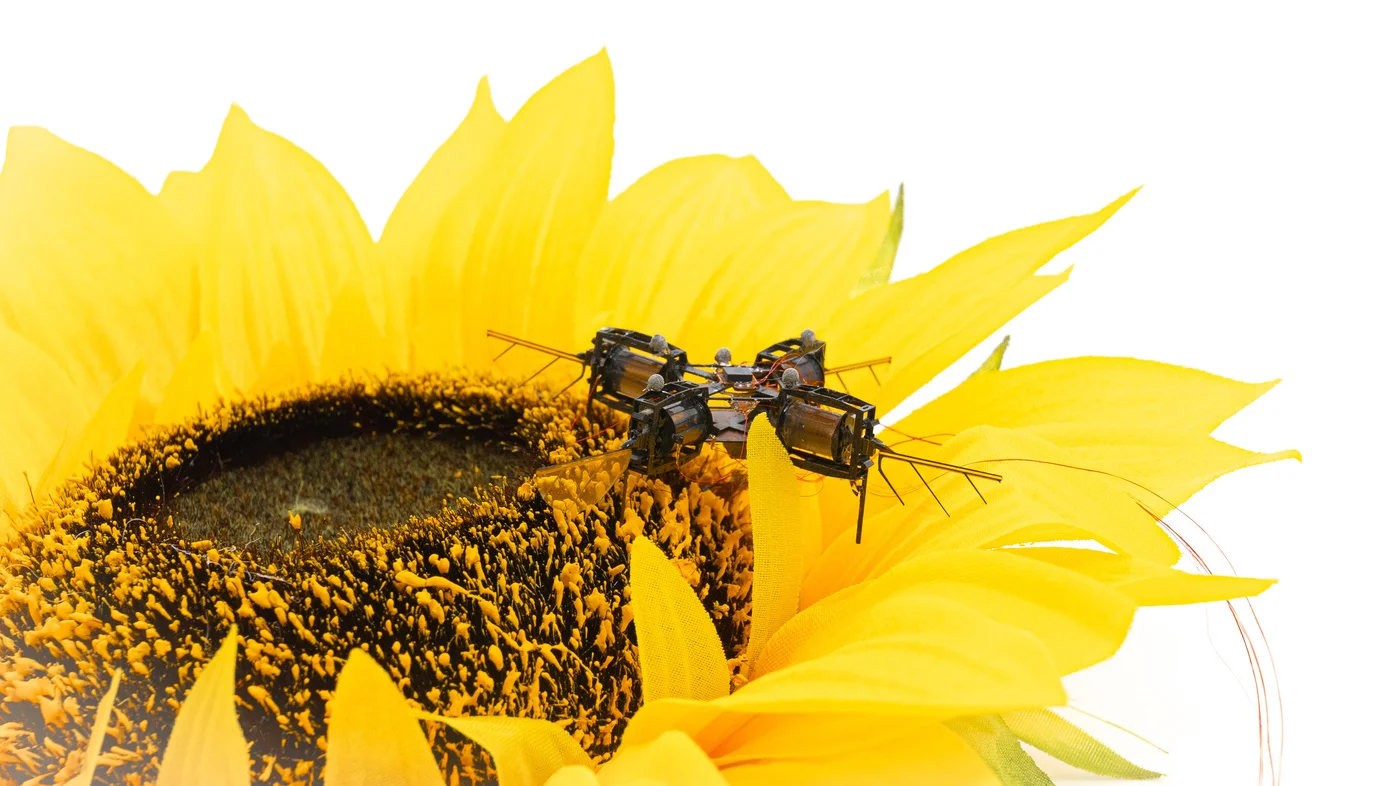
MIT’s tiny flying robot has navigated around plants and landed on a sunflower without external tracking cameras. The work, featured in The Rundown, brings researchers closer to machines the size of insects that can guide their own flight.
MIT announced the advance on November 18. The team’s February 9, 2026 preprint describes a human guiding the sunflower flights by joystick while an external computer handled computation. Researchers tested onboard computing separately.
What the robot can do
The robot weighs 1.29 grams. According to MIT, its electronics package weighs 244 milligrams and combines motion and distance sensors with a small processor. These sensors help it judge its movement without cameras tracking its position from outside.
In the onboard computing tests, the researchers report 10 seconds of hovering and seven seconds of following position commands. The paper also reports 65% greater hovering position error with onboard sensing than with external camera tracking, though accuracy remained on the scale of centimeters.
The power challenge
An external supply still powers the robot. MIT says about 94% of its power goes to the artificial muscles and wings.
In Harvard’s 2019 RoboBee demonstration, solar cells enabled flight without a power cable under lamps about three times as intense as sunlight on Earth. That robot lacked onboard steering and control.
The University of Washington’s 2018 RoboFly drew power from a laser aimed at a cell on the robot. It could take off and land, but leaving the beam cut its power.
Why it matters
The promise is a new class of tiny aerial machines that could inspect crops, monitor infrastructure or enter spaces conventional drones can’t reach. MIT’s progress moves more of the hardware needed to navigate onto the robot.
Moving navigation hardware onboard could reduce the support equipment needed at an inspection site. In MIT’s December 2025 agility demonstration, an external computer ran the controller as the robot made fast turns and repeated flips. The new sensing and computing tests bring more of that work onto the machine.
MIT proposes crop health monitoring and pest detection as possible applications. Growers would need the robot to approach plants repeatedly, collect useful inspection data and avoid damage to leaves and flowers. Reliability outdoors remains an open question.
For infrastructure crews, access also depends on power. Washington’s RoboFly researchers suggested locating methane leaks around building pipes. A robot that reaches such a spot would need enough energy to gather readings and move through the area. Reliance on external power could restrict that access, as RoboFly’s need to stay in its laser beam illustrates.
The battery challenge could also change the robot’s size. In their preprint, the researchers estimate that batteries and power electronics would add 1 to 1.5 grams and require a 15% to 35% increase in size. Those figures are projections. A larger design could limit access to narrow spaces, and the robot would need enough lift for both power hardware and inspection sensors.
MIT also identifies recognizing objects with a camera and avoiding obstacles as development goals. The robot’s flight time on a battery and its capacity to carry inspection sensors remain open questions.
Sources & further reading
- 01therundown.ai ↗
- 02This featherweight, flying robot carries its own sensors and computers | MIT News | Massachusetts Institute of Technology ↗
- 03Controlled Flight of an Insect-Scale Flapping-Wing Robot via Integrated Onboard Sensing and Computation ↗
- 04The RoboBee flies solo ↗
- 05The first wireless flying robotic insect takes off | UW News ↗
- 06MIT engineers design an aerial microrobot that can fly as fast as a bumblebee | MIT News | Massachusetts Institute of Technology ↗
This story builds on reporting from The Rundown newsletter on November 19, 2026.