MIT builds a thin swimming robot powered by living muscle
MIT’s thin robot swims with living muscle cells and steers with light. It could lead to smaller, cheaper robots, though it still tires in the lab.
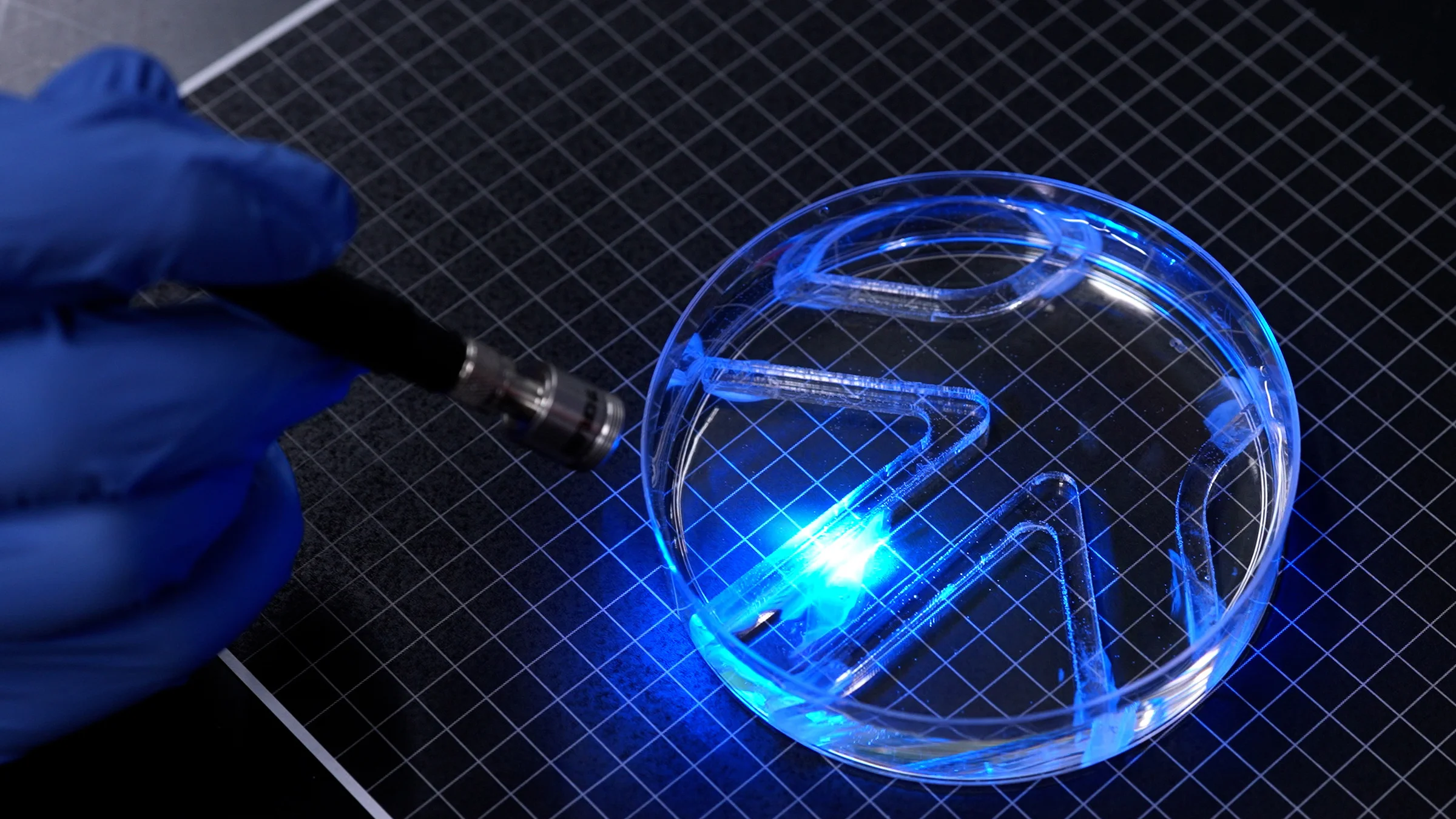
MIT engineers have built a robot the size of a stick of gum that swims with living mouse muscle cells. In a demonstration announced on September 29, researchers steered it through a maze in a Petri dish by aiming blue light at its fins.
The swimmer, featured in The Rundown’s October 1 edition, combines thin muscle films with a soft gel support. The team reports that these films produce more force for their volume than earlier muscle designs, which could help make future robots smaller and cheaper to build.
How the swimmer moves
Each of the robot’s two gel fins carries mouse muscle cells genetically engineered to contract when exposed to blue light. Researchers control the fins independently, adjusting light pulses to change direction and speed. In the maze trial, they moved the light source by hand. The swimmer reached roughly four body lengths per minute.
Microscopic grooves guide the cells into aligned fibers, while the gel bends with their contractions. The paper, published September 28 in Advanced Functional Materials, reports a muscle layer less than 15 micrometers thick on a gel support 0.5 millimeters thick.
Daily training with light pulses increased the movement produced by each contraction about fourfold compared with untrained controls, the authors report. They also report about 20 times as much force per unit of muscle volume as earlier studies of 3D muscle made from the same type of mouse cells.
Why it matters
Getting more force from fewer muscle cells could make robots driven by living tissue smaller and cheaper to build. MIT researcher Ritu Raman points to possible construction savings from thinner muscle designs. For labs building these machines, the opportunity is to grow less tissue for a given task.
That possibility rests on both the cells and their support. Grooves help align the fibers, and the gel must accommodate their pull for the fin to move. The full cost would also include fabrication, cell care, daily training, and the light equipment needed for control. Whether the thinner muscle lowers that total remains uncertain.
Soft, flexible bodies could eventually suit delicate work in fragile aquatic environments. Raman has proposed environmental monitoring as one possible application. A body that bends easily could help a robot interact gently with its surroundings, but ecological safety would need testing in the water and habitat where it would operate.
The current swimmer depends on an external light source directed by a person. A monitoring version would need a way to gather readings and return data, plus reliable control and retrieval outside the lab.
Endurance presents an immediate limit. The paper reports that the muscle films remained functional through day 31 in lab culture, with fresh nutrient liquid supplied daily. Under continuous light pulses at two per second, the swimmer showed no measurable forward movement at 30 minutes. For practical work, useful swimming time would matter alongside the tissue’s lifetime in culture. How long recovery takes, and how reliably the swimmer can work again after resting, remain open questions.
Sources & further reading
This story builds on reporting from The Rundown newsletter on October 1, 2026.