Meta’s Muse Wonder reaches the AI frontier
Meta’s Muse Wonder puts the company among AI’s leaders. Its data centers, vast audience, and Muse app could make that progress harder for rivals to match.
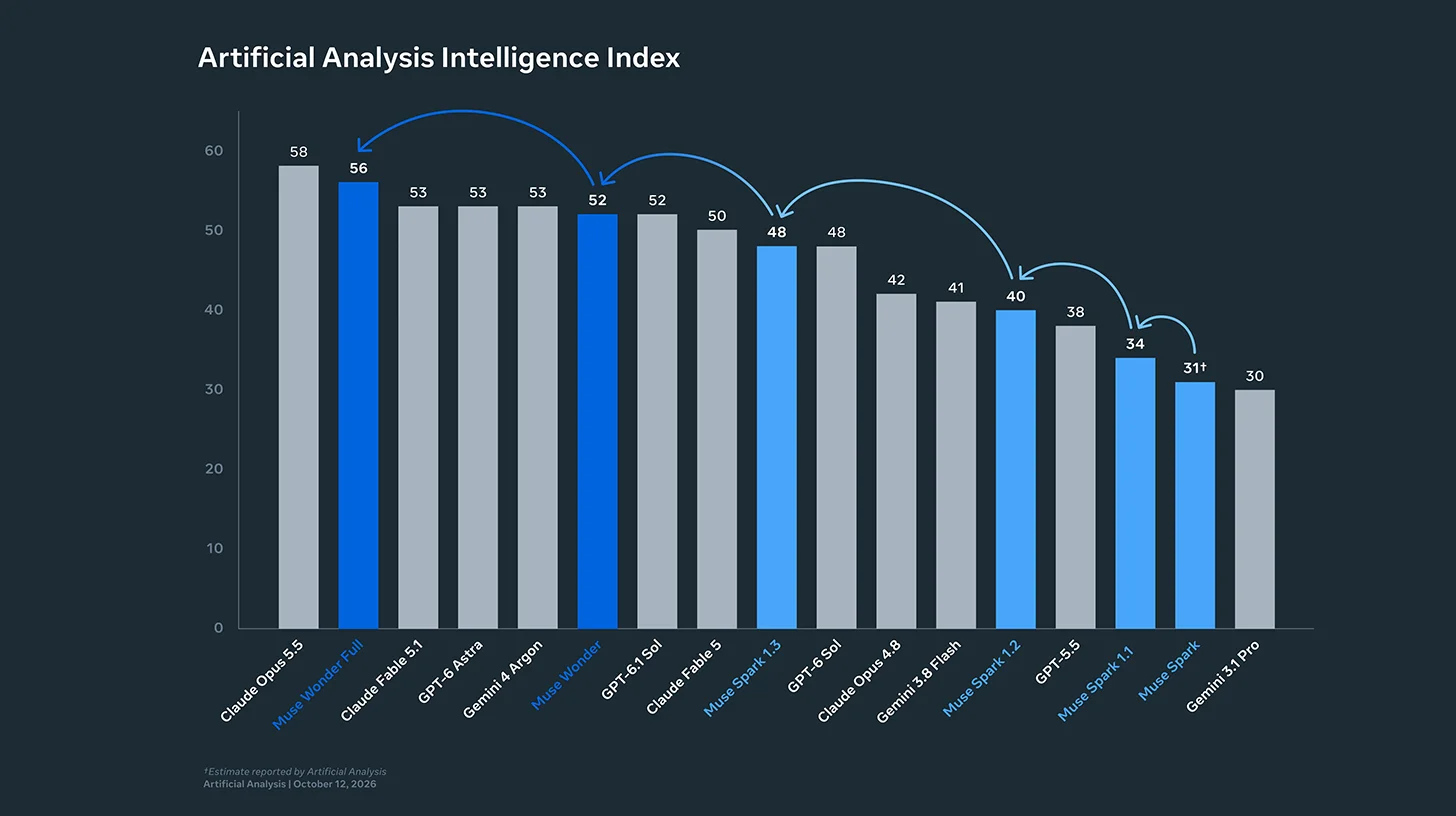
Meta Superintelligence Labs released Muse Wonder and Muse Wonder Full on October 12, putting Meta among the leaders in AI capability. Wonder, previously known as Watermelon, arrives after Meta spent 14 months overhauling its AI effort.
As The Rundown reported, both models are closed, a break from Meta’s open Llama era. The strongest version, Wonder Full, is available only through Muse Code subscriptions.
A fast climb in capability
At maximum reasoning effort, Artificial Analysis scored standard Wonder at 52 and Wonder Full at 56 on its Intelligence Index. Spark 1.3 scored 48 six weeks earlier. Full improved across all 10 evaluations that make up the index and reached the top three on six.
Full’s score matches Sonnet 5.5, while Gemini 4 Argon scored 53. That places Meta in a field with several close competitors.
In Meta’s published comparison, Full outperforms GPT-6 Astra and Opus 5.5 on tests of legal work, extended coding tasks, and memory. Opus leads on health, computer use, and the ProgramBench coding test.
What buyers can get
Standard Wonder is live on Meta’s API, priced per million tokens at $4 for input, $0.20 for cached input, and $20 for output. Full requires Muse Code’s $50 Power Usage or $200 Maximum Usage monthly plan.
Consumer access has a less definite schedule. Meta’s October 12 announcement says Muse integration is coming soon, starting with subscribers, and gives no firm rollout date.
Why it matters
Meta now has a credible place alongside OpenAI and Anthropic at the frontier. Its rivals also have to contend with computing infrastructure, vast consumer reach, and an agent app already attracting users. That combination could prove difficult for competing labs to replicate.
Meta says it trained both models at its Prometheus data center. That connects its infrastructure directly to this release. The company reported $31.08 billion in capital spending in the second quarter and $90.26 billion in cash and marketable securities. Those figures cover Meta’s wider business and point to resources that could sustain further training and deployment. Heavy spending still has to earn a return.
Meta also reported 3.60 billion daily active people across its family of apps in June. That reach offers a potential path for introducing capable agents to a vast audience. The commercial test is how much of that reach Meta can turn into regular Muse activity and paid subscriptions.
Muse gives the model gains an existing product to improve. Sensor Tower estimated more than 3.4 million downloads through September 24, TechCrunch reported. That shows early interest; retention and paid conversion remain open questions.
Meta describes Active Memory and Active Focus in terms of retaining relevant context, working through obstacles, and checking before important actions. Better memory and reasoning could help Muse finish more involved tasks. Whether Muse delivers more reliable task completion in daily work remains an open question.
Developers face a further tradeoff. The standard API model scores below Full, and its token prices do not guarantee the cheapest completed task. AA measured $4.52 per Intelligence Index task for standard Wonder, compared with $3.26 for Astra and $5.98 for Opus 5.5. These figures cover AA’s benchmark workloads. Teams weighing a switch should test standard Wonder’s cost and reliability on their own work.
Sources & further reading
- 01therundown.ai ↗
- 02Muse Wonder: A Frontier Model For Personal & Professional AI Agents ↗
- 03Muse Wonder and Muse Wonder Full: a material jump in intelligence over previous Meta models | Artificial Analysis ↗
- 04Changelog | Artificial Analysis ↗
- 05Muse Wonder | Meta ↗
- 06Meta - Meta Reports Second Quarter 2026 Results ↗
- 07Meta is putting its muscle behind Muse as the AI app takes off | TechCrunch ↗
This story builds on reporting from The Rundown newsletter on October 13, 2026.