Mecka reportedly nears $500M valuation as robot data draws investors
Mecka reportedly nears a $500M valuation as robot training data draws investors. Human demonstrations still need engineering and tests to help robots learn.
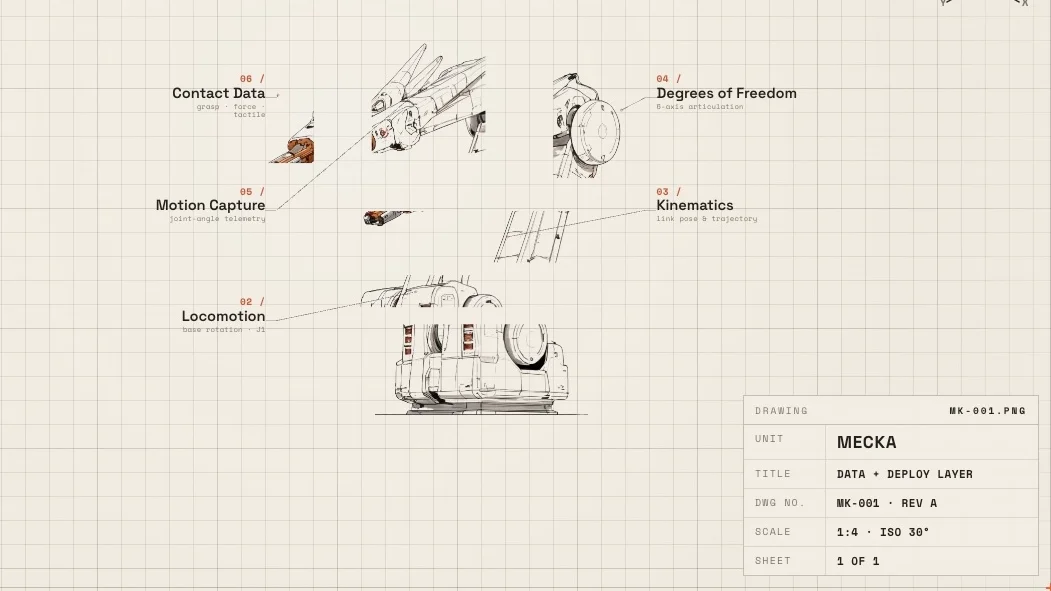
Mecka AI is reportedly nearing a funding round at a valuation of about $500 million, as investors back companies collecting the human data robots need to learn everyday tasks. TechCrunch reported on September 11 that Sequoia was leading the talks.
Mecka’s approach, covered in The Rundown’s September 14 issue, starts with paid human demonstrations. People record themselves making coffee, fixing cars, and performing other tasks with smartphones and body sensors. Mecka turns that material into training data.
A market for robot data
In June, Fortune reported that Mecka had raised $60 million across a $25 million Series A and a further $35 million round. The company said signed contracts put it on track to end 2026 generating revenue at a pace equivalent to $100 million a year.
Rival XDOF was reportedly in talks for a Series B at a valuation of about $1.2 billion on September 4, following a $70 million raise in June. Both companies’ reported valuations are provisional figures from financing talks. TechCrunch also reported that Scale AI and Micro1 were expanding into robotics data.
Mecka currently markets access to datasets, collection commissioned by customers, model testing, and support for deployment. Its stated role is to sit between robot hardware, AI models, and the companies putting machines to work. That gives it several services to sell around the recordings themselves.
Why it matters
Humanoid developers face a shared bottleneck. Robots need large amounts of data from the real world before they can handle everyday tasks reliably. Mecka and XDOF’s reported valuations show how quickly supplying that data is becoming a business of its own. A specialist supplier could take on some of the work of gathering and preparing demonstrations for robot makers.
The product can include the tools to judge whether training worked. In its June 17 announcement, XDOF described more than 130,000 recorded task sequences covering 195 tasks involving two arms. The company also described evaluation services that define scoring rules and test robot behavior in simulation and on real machines.
Buyers can judge a dataset by whether it helps their robot perform a specific task. Collection, preparation, and testing can all form part of the purchase, giving suppliers a role in turning demonstrations into useful robot behavior. This helps explain why demand for training data can support a specialized supplier business.
Human demonstrations still have to match what the robot is learning. In EgoVerse research revised on July 7, a team that included Mecka affiliates reported that human demonstrations generally improved robot learning. The experiments combined human and robot data, and the gains depended on how closely the demonstrations matched the robot’s learning goals. The researchers also reported a decline in performance for one robot on a grocery bagging task.
For developers, human recordings offer a way to broaden the material available for training. They also bring work to select relevant examples and test how well learning transfers to the customer’s hardware. That work affects both the value of a dataset and the cost of adopting it.
Open datasets could also shape how suppliers compete. XDOF offers its datasets under the Apache 2.0 license. With some training material freely available, suppliers may have to compete through custom collection, preparation, evaluation, and help with deployment. Mecka’s advertised services fit that possibility. How much customers will pay for this work, and how costly it is to deliver, remain open business questions.
Sources & further reading
This story builds on reporting from The Rundown newsletter on September 14, 2026.