Anthropic’s Jack Clark moves AI self-improvement forecast to 2027
Anthropic’s Jack Clark now favors 2027 for AI to fully improve itself, citing gains in research judgment that could speed up work on future generations of AI.
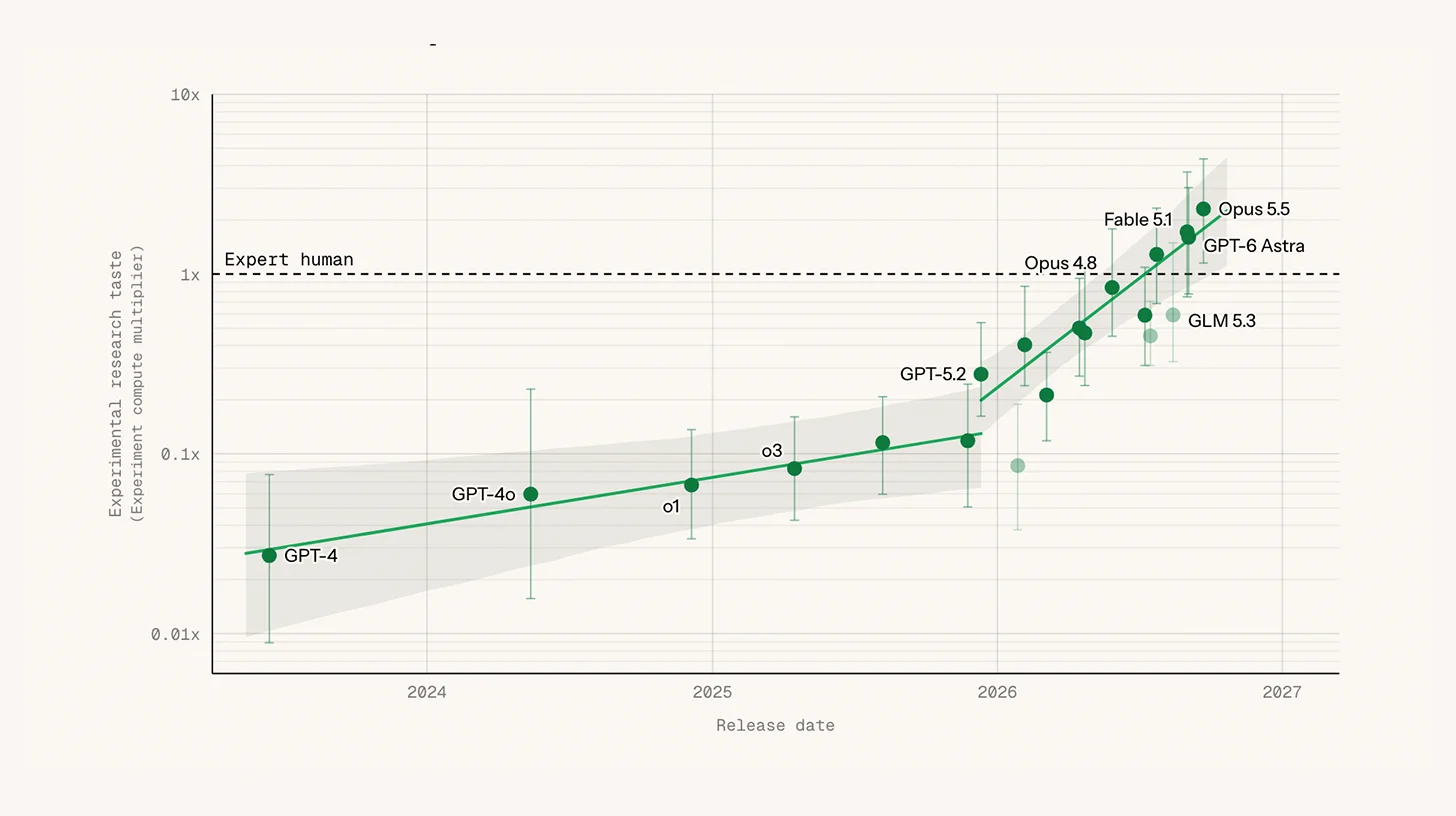
Anthropic co-founder Jack Clark has moved his forecast for when AI could fully improve itself to 2027 from 2028, pointing partly to a new test of research judgment. In his October 12 post, he cites TasteVal as a reason to reconsider whether models can supply the creativity needed to drive AI research.
The forecast, covered in The Rundown, concerns recursive self-improvement, a loop in which an AI system conducts the research needed to train a stronger successor that can repeat the process. This is Clark’s personal prediction, and he gave no updated numerical odds.
What TasteVal measures
In his May 4 post, Clark put the odds of automated AI research capable of training a successor at 30% for 2027 and about 60% by the end of 2028. His hesitation centered on creative leaps models had yet to show decisively.
P-Zero Research’s TasteVal gives models eight fixed AI research problems. They design experiments and interpret results while a separate, fixed coding agent handles implementation. The human comparison draws on the best attempt per task from 24 experts recently affiliated with organizations including OpenAI and Google DeepMind.
P-Zero reports that Anthropic’s Opus 5.5 led the field on its measure of experimental compute efficiency. Its paper estimates $282 per Opus 5.5 run versus $9,123 per human run, putting the model at roughly one-thirtieth the average cost per benchmark attempt. The accounting includes model API charges and GPU time priced at $2.50 an hour, plus human pay at $119 an hour.
The authors acknowledge that the tasks have results that are easy to check and that their human baseline excludes top researchers. Opus 5.5 also refused one task, which they treated as missing data. A comparison across the other seven tasks produced a similar result.
Coding gains expose other limits
Anthropic has already reported a jump in coding output. In an October 13 engineering post, the company says code changes merged each day rose from about 2,500 in May to more than 30,000 in September. It says “coding is no longer the bottleneck” and identifies source control, builds and continuous integration as the new constraints.
Why it matters
OpenAI has set a target of March 2028 for an automated AI researcher. Its plan connects that researcher to repeated improvements in AI, while people guide the work. Alongside Clark’s shorter forecast, that ambition points toward AI doing more of the research that determines what future systems can do.
For research labs, better experimental judgment could stretch an existing computing budget further. If TasteVal’s gains carry over to real research, teams could get more useful results from the same resources. That transfer remains uncertain, especially for work that starts with deciding which research problems deserve attention.
The larger speedup would come from repeated feedback. A capable AI researcher could help train a stronger successor, which could then contribute more effectively to the next development cycle. If that loop works, improvements could compound across generations. The real acceleration may not have started, even with the rapid gains labs report today.
Anthropic’s experience shows how faster output can shift the work elsewhere. Research teams could face more demands on testing, integration and checking results as agents produce more. Labs would need to judge progress by completed, validated work to understand how much the extra output helps.
Human direction also remains part of OpenAI’s goal. People choose research priorities, assess results and decide whether to scale, pause or deploy. The company reports that more than half of successful tasks estimated to take a person four to eight hours involved intervention. Faster experiments could increase the demand for review and judgment.
OpenAI also says it does not yet know how to achieve full recursive self-improvement safely. Tracking how often people must step in, and whether research results hold up, would help labs judge progress toward a reliable cycle of models improving their successors.
Sources & further reading
- 01therundown.ai ↗
- 02importai.substack.com ↗
- 03Import AI 455: AI systems are about to start building themselves. ↗
- 04Introducing TasteVal – P-Zero Research ↗
- 05TasteVal: Measuring the Experimental Research Taste of AI Systems Against Human Experts ↗
- 06Redesigning source control at Anthropic \ Anthropic ↗
- 07Research acceleration: The view inside OpenAI | OpenAI ↗
This story builds on reporting from The Rundown newsletter on October 14, 2026.