Insilico’s AI-designed drug shows an early aging signal in lung disease patients
Insilico’s rentosertib shifted aging clock estimates in a small study, offering an early glimpse of AI’s medical promise while leaving major questions.
Insilico Medicine has published an exploratory analysis showing that rentosertib, a drug candidate designed with AI, shifted blood markers toward younger age estimates in patients with idiopathic pulmonary fibrosis. The September 7 study in Nature Biotechnology offers an intriguing signal, but it cannot establish that the drug slows aging.
Rentosertib is being developed for idiopathic pulmonary fibrosis, or IPF, a disease in which scarring progressively damages the lungs. Investigators report that AI helped identify the target protein, TNIK, and design a molecule to inhibit it. That gives the research a concrete connection between AI drug discovery and testing in patients.
Originally covered in The Rundown’s September 8, 2026 newsletter.
What the aging analysis found
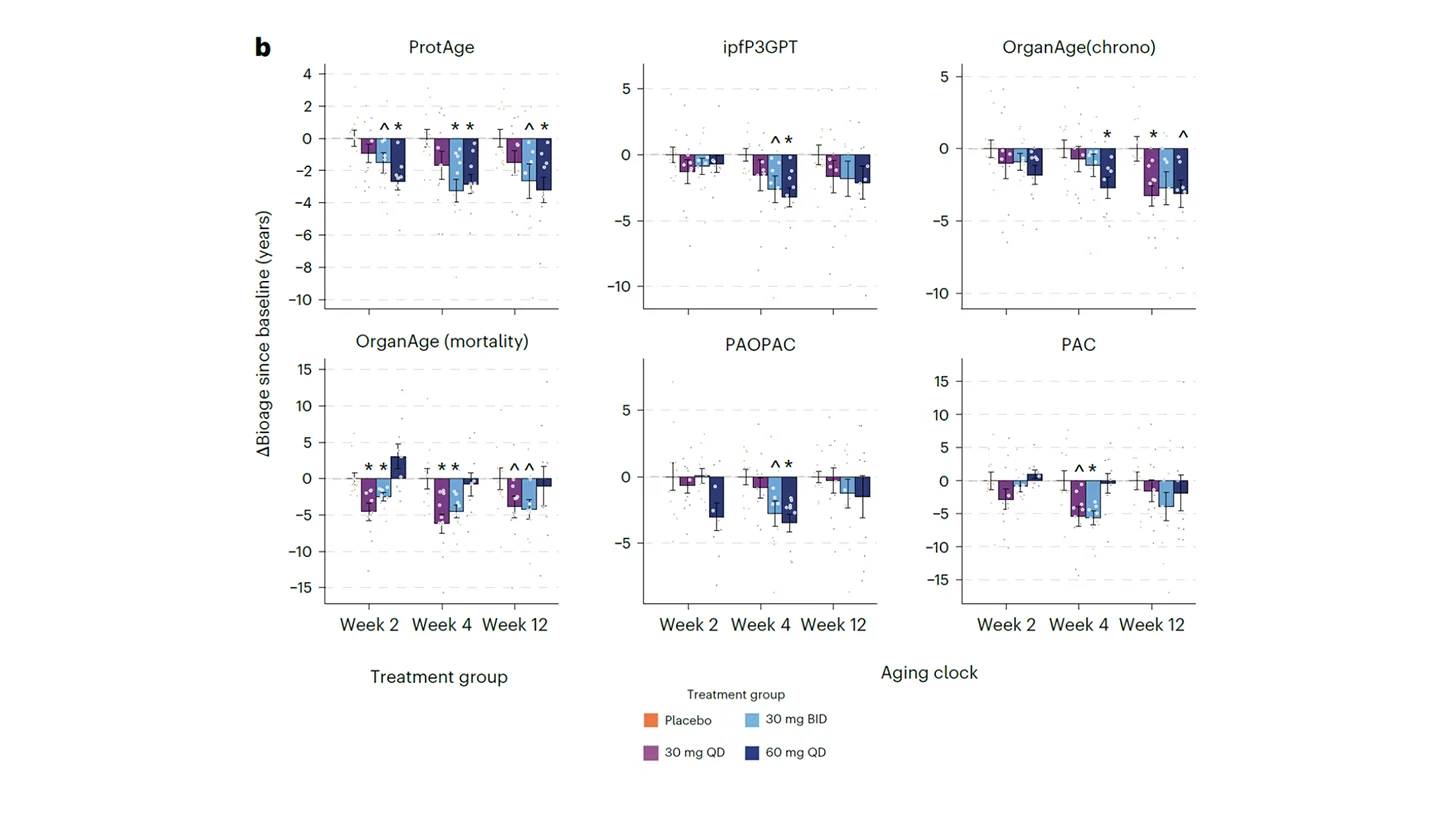
Researchers examined blood samples from 42 participants in an earlier rentosertib trial. Six aging clocks, models that estimate age from biological markers, showed younger predicted profiles across treated groups. The findings varied by dose, clock and measurement time.
At week four, four clocks estimated age reductions of 2.71 to 3.46 years among patients receiving 60 mg once daily. A different regimen, 30 mg twice daily, produced broader agreement across the clocks. Researchers also compared age-associated protein patterns with data from 55,319 UK Biobank participants, who served as an external reference rather than additional trial patients. These results come from the aging analysis.
Those numbers describe changes in model estimates. They do not demonstrate that patients gained years of healthy life. A protein associated with fibrosis, LTBP2, influences all six clocks, so their agreement could partly reflect a shared response to the lung disease. Statistical support was also uneven, with 21 of 54 comparisons meeting the study’s reported threshold and weaker significance by week 12. Insilico’s founder and employees are among the coauthors.
The lung trial provides the medical anchor
The underlying trial enrolled 71 patients at 21 sites in China and ran from July 2023 to June 2024. The trial scheduled 12 weeks of treatment per patient. Its results appeared in Nature Medicine in June 2025.
The randomized, blinded trial primarily assessed adverse events. Lung function was a secondary outcome. At 60 mg once daily, mean forced vital capacity, a measure of how much air a person can forcefully exhale, increased by 98.4 milliliters. The placebo group recorded a mean decline of 20.3 milliliters.
Safety and durability remain important questions. Sixteen participants discontinued treatment, with liver toxicity and diarrhea among the leading adverse-event reasons. A short trial conducted in one country cannot establish lasting benefit or long-term safety.
Why it matters
A medicine that delivers a meaningful benefit could give people a more tangible reason to value AI than a marketing campaign. Rentosertib offers an early glimpse of that possibility. Its path connects an AI-discovered target and an AI-designed molecule to human testing, where the stakes include whether patients can retain lung function and tolerate treatment.
For people with IPF, the strongest reason to follow this research is the possibility of a treatment that improves their health. The lung-function result provides a concrete medical signal. Larger studies showing a durable benefit, alongside acceptable safety, would make the case for AI’s contribution substantially more persuasive. Whether that would shift public attitudes remains an open question.
The aging analysis adds another possibility for researchers. Disease trials could include aging measurements from the outset, allowing teams to investigate broader effects alongside clinical outcomes. The study authors propose this direction. The difference between the regimen with broader clock agreement and the one with the largest lung-function gain gives them something to investigate, although shared disease markers make the findings difficult to interpret.
That creates a practical tradeoff. Additional biomarkers may reveal effects worth pursuing, while also producing signals whose meaning for patients is uncertain. Changes in clock estimates need a clearer connection to health outcomes before they can support claims about slowing aging.
The wider race to bring AI-designed medicines to patients is still early. A 2024 analysis of AI-native biotech pipelines reported approximately 40% success in phase II, comparable with historical industry averages and based on a small sample. That historical result offers little basis for assuming AI candidates will reliably clear later development hurdles.
Anthropic CEO Dario Amodei’s June 2026 essay forecasts a growing flow of drug candidates and warns that biomedical evaluation systems may struggle to keep pace. Rentosertib illustrates why that evaluation matters. Convincing efficacy, tolerable treatment and eventual access are the steps that could turn promising discovery into the kind of medical progress people can experience.
Sources & further reading
- 01therundown.ai ↗
- 02Integration of proteomic aging clocks in a phase 2a clinical trial supports simultaneous geroprotective assessment | Nature Biotechnology ↗
- 03A generative AI-discovered TNIK inhibitor for idiopathic pulmonary fibrosis: a randomized phase 2a trial | Nature Medicine ↗
- 04How successful are AI-discovered drugs in clinical trials? A first analysis and emerging lessons - PubMed ↗
- 05Dario Amodei — Policy on the AI Exponential ↗
This story builds on reporting from The Rundown newsletter on September 8, 2026.