Inception says Mercury 3 generates over 1,000 tokens a second
Inception says Mercury 3 generates over 1,000 tokens a second. Its diffusion model targets interactive AI apps as rivals invest in faster responses.
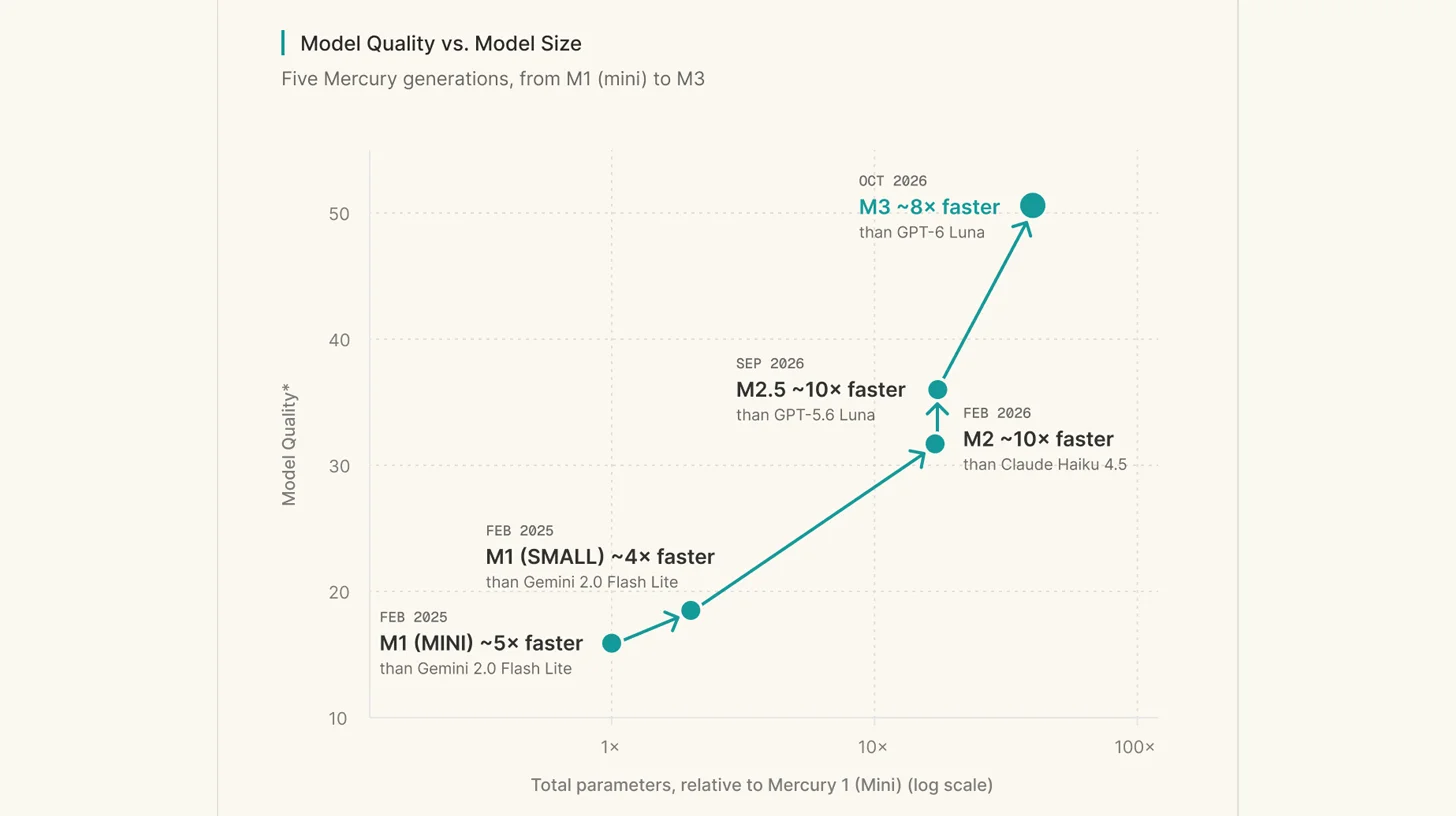
Inception launched Mercury 3 on October 19, a diffusion language model it says generates 1,068 output tokens per second on NVIDIA GPUs. The company reports speeds four to eight times those of OpenAI’s GPT-6 Luna and Anthropic’s Claude Haiku 5.5.
The model, featured in The Rundown’s latest issue, targets apps where any lag shows. Inception says early users are running live tutors, voice customer support and agents that browse the web.
How Mercury 3 works
Autoregressive language models build answers one token at a time. Mercury’s diffusion approach drafts many tokens at once and refines them, a method described in Inception’s 2025 research on the Mercury family.
Inception says Mercury 3 has more than 40 times Mercury 1’s total parameters while maintaining similar speeds. The company also presents it as competitive on quality, though its benchmark table shows mixed results. At medium effort, Luna and Haiku each lead on some tests.
Inception’s list prices are $0.20 per million input tokens and $0.70 per million output tokens. A 50% launch discount lowers those rates to $0.10 and $0.35, respectively. The company has not specified an end date for the offer.
Why it matters
Mercury 3’s clearest opening is interactive work where a capable answer arrives quickly enough to keep an exchange moving. Replacing frontier models on hard reasoning would require evidence beyond these comparisons with peers built for speed.
For teams building tutors or voice support, shorter pauses could help a conversation flow. Faster replies could shorten repeated steps in a browser agent’s work. Teams could test Mercury for routine exchanges, with a frontier model handling difficult planning or escalation. That choice would depend on whether Mercury completes those steps accurately enough to avoid retries.
OpenAI is also selling speed directly. On September 29, it announced GPT-6 Astra Ultrafast, advertising up to eight times faster token generation in Codex, reaching 300 tokens per second, and up to six times faster generation in the API. Comparing Astra with Mercury would require tests under the same conditions.
Separately, OpenAI’s January 14 agreement with Cerebras calls for 750 MW of compute capacity designed for fast responses, with capacity scheduled to come online in phases through 2028. The investment and premium Ultrafast tier show OpenAI competing on speed through hardware and pricing. Inception is betting that a different model design can give it an advantage.
For developers, the practical test is how long an app takes to deliver a useful result. OpenAI’s Ultrafast documentation warns that time spent opening connections can reduce the gains from faster generation. It recommends keeping a WebSocket connection open, especially for agents that call tools repeatedly. Faster text generation can still leave users waiting for the rest of a workflow.
Teams evaluating Mercury should measure time to the first useful response, total task time, success rate and the longest waits under realistic traffic. They should count retries in the cost of completing a task and test the budget at both launch and list prices.
Sources & further reading
This story builds on reporting from The Rundown newsletter on October 20, 2026.