Physicist credits GPT-6 Astra in unreviewed quantum gravity paper
An unreviewed quantum gravity paper credits GPT-6 Astra with help on calculations and proofs, drawing interest and criticism from physicists.
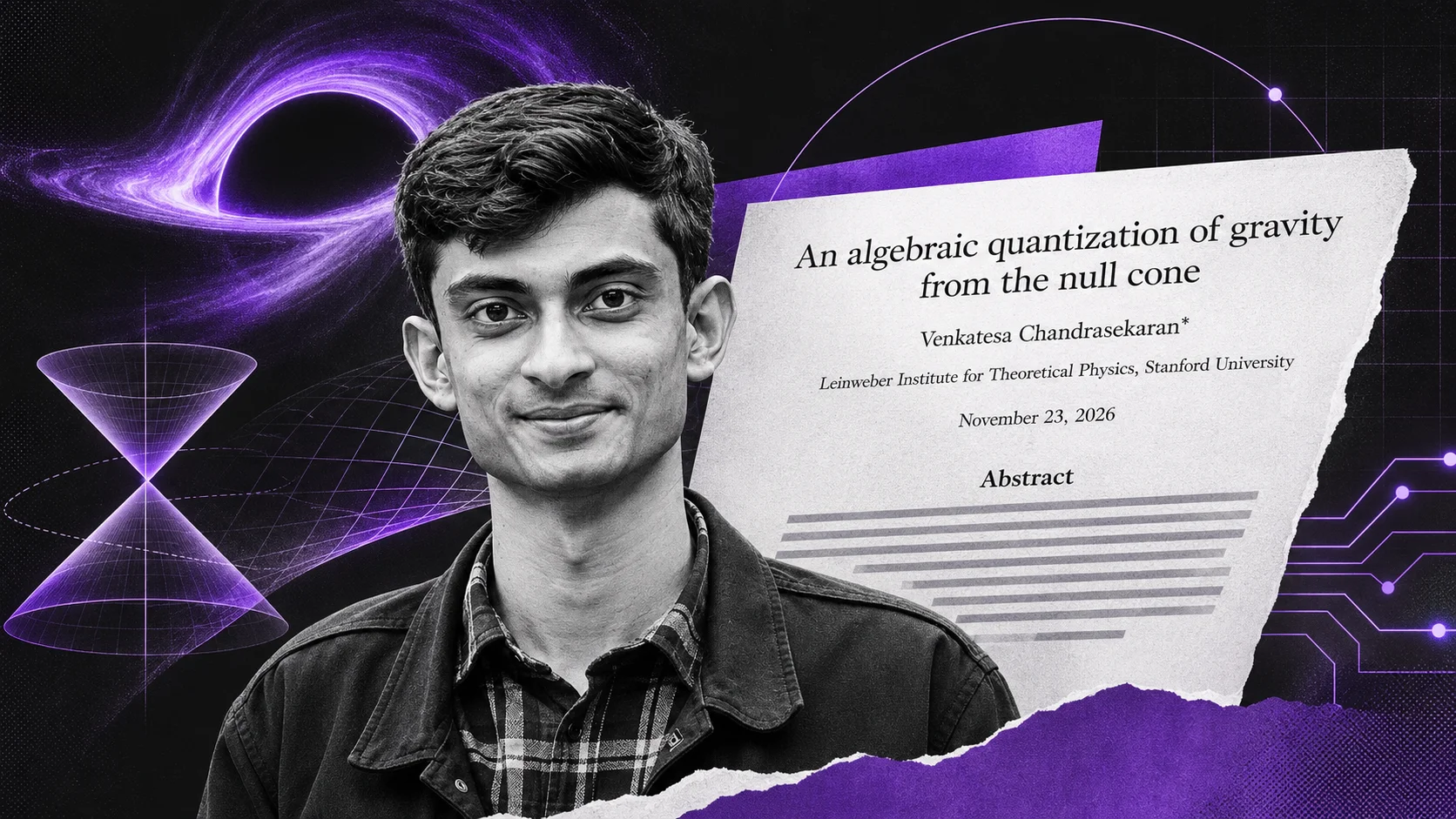
Stanford and OpenAI physicist Venkatesa Chandrasekaran has released a paper proposing a way to describe gravity with quantum mechanics. The unreviewed proposal spans 83 pages and credits GPT-6 Astra with helping develop several calculations and proofs, as The Rundown reported.
The paper was submitted to arXiv on November 25. It describes gravity in empty space and leaves out matter.
What the paper claims
The proposal builds on intersecting null cones, boundaries defined by the paths light can take through spacetime. Chandrasekaran claims it produces finite answers for some quantum gravity calculations, avoiding infinities that can break the math.
He also reports matching a formula for black hole entropy, including a known correction, and recovering Einstein’s equations at low energies through the first level of quantum corrections.
In the acknowledgements, Chandrasekaran describes months of collaboration with Astra involving roughly 400 million tokens. OpenAI supplied the computing resources, and Chandrasekaran is the paper’s sole author.
Praise and pushback
Business Insider reported that Sam Altman praised Chandrasekaran’s persistence, while UCL’s Jonathan Oppenheim said AI had flagged more than a dozen issues. Columbia’s Peter Woit called the paper a “publicity stunt.”
Physicist Sean Carroll expressed conditional interest, describing the proposal as potentially important if true and as human work assisted by AI calculations. The paper remains unreviewed as of November 27.
Why it matters
If the work holds up, physicists could gain new mathematical tools to study places where Einstein’s gravity and quantum mechanics must work together, including the inside of black holes and the first moments after the Big Bang. Those have long been goals of quantum gravity research, as Stanford/SLAC physicist Lance Dixon explained in a 2015 interview.
For theorists, finite answers could make it possible to carry a calculation through and examine its consequences. Recovering established formulas would provide a useful check on whether the framework fits known physics. Its ability to describe nature would need further support.
The proposal’s current scope limits that promise. It covers empty space, so physicists would need to extend it to include matter before applying it more broadly. Black hole interiors and the earliest universe remain research goals beyond the results claimed so far.
If the physics survives scrutiny, the work could also show AI helping advance fundamental theory beyond solving predefined problems. The potential contribution is help with developing calculations and proofs during a search for a new description of gravity.
In an OpenAI Forum interview published October 16, Chandrasekaran described setting a research question, supplying relevant material, and specifying what would prove a result wrong. He also described intervening when an agent changed a claim or left a derivation incomplete.
For researchers exploring similar methods, the potential help with derivations comes with a need for clear tests and close supervision. The model’s precise contribution to this paper and any savings in research time remain uncertain. Independent checks of the mathematics are the next step toward assessing its wider promise.
Sources & further reading
- 01therundown.ai ↗
- 02[2611.34924] An algebraic quantization of gravity from the null cone ↗
- 03An algebraic quantization of gravity from the null cone ↗
- 04An algebraic quantization of gravity from the null cone ↗
- 05businessinsider.com ↗
- 06@seanmcarroll.bsky.social on Bluesky ↗
- 07Q&A: SLAC Theorist Lance Dixon Explains Quantum Gravity ↗
- 08Event Replay: Using AI at Scale to Solve Math and Science Challenges: Discussion with an OpenAI Researcher - Video | OpenAI Forum ↗
This story builds on reporting from The Rundown newsletter on November 27, 2026.