Google’s Gemini 4 Neon extends its rapid run of model releases
Google’s Gemini 4 Neon reaches Pro users with strong reported scores. Its fourth release in under two months points to a shift in how fast Google ships.
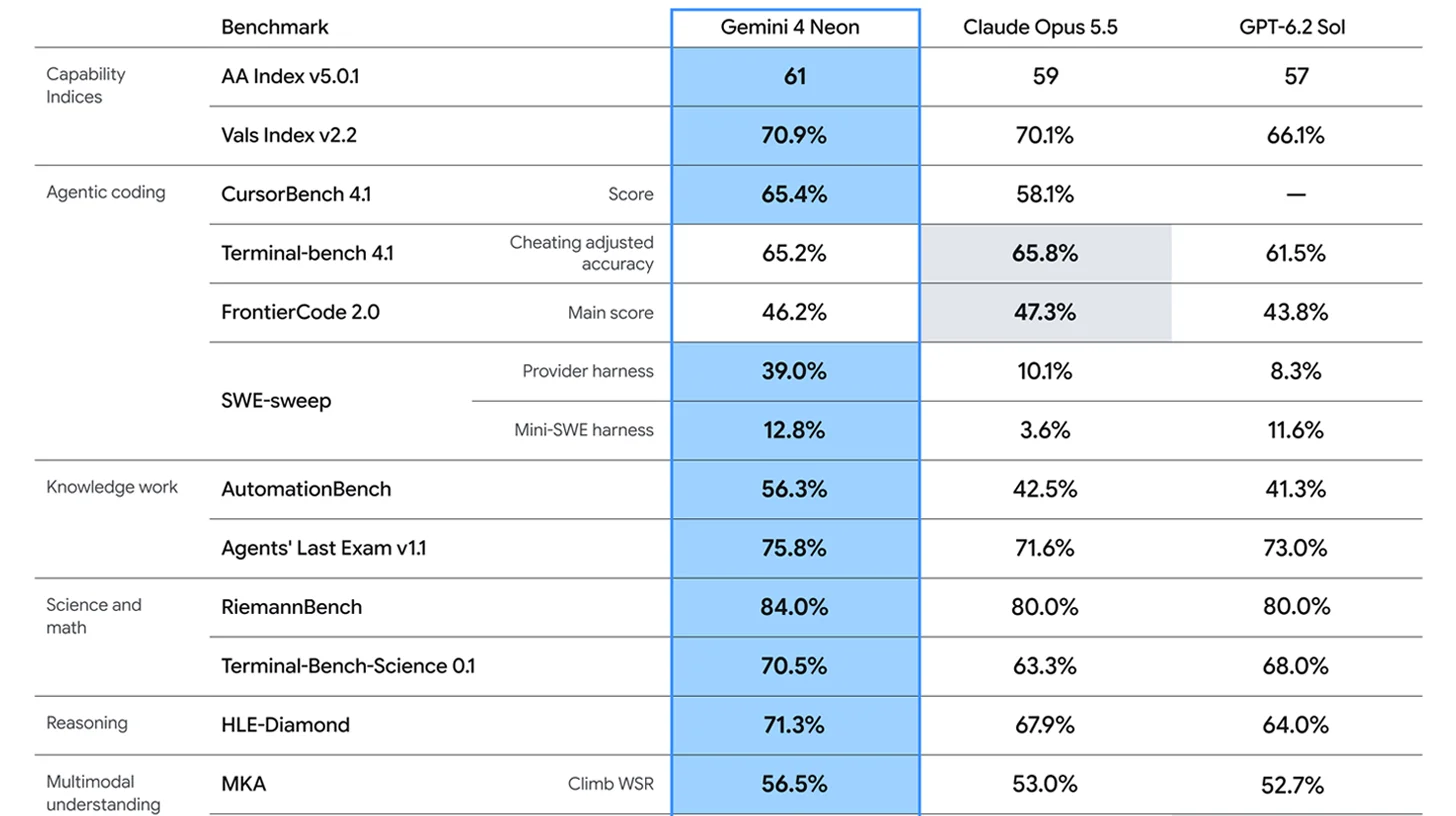
Google released Gemini 4 Neon on Nov. 18, its fourth Gemini 4 model in under two months. The launch extends the shipping spree covered by The Rundown with a model Google positions between Carbon’s deeper reasoning and Hydrogen’s faster execution.
Neon is rolling out through Google’s API, AI Studio and enterprise products. Pro and Ultra subscribers can access it in the Gemini app and Antigravity. It has a context window of one million tokens.
Strong scores, with limits
Google’s model card compares Neon with Anthropic’s Claude Opus 5.5 and OpenAI’s GPT-6.2 Sol. Neon leads the available rivals in 16 of 19 score rows. But three rows omit one rival. Among the 16 rows that include all three models, Neon beats both competitors in 13.
Google reports strong results in long context, automation and cybersecurity tests. On GraphWalks, Neon scores 95.2, against 66.8 for Opus and 80.1 for Sol. Opus leads on Terminal-Bench 4.1 and FrontierCode 2.0, while Sol leads on Chartography.
Google also says Neon is adapted from Carbon and can still hallucinate. Its benchmark results give developers reasons to test it, while leaving open how well it will handle their documents and workflows.
What Neon costs
Neon’s API costs $3 per million input tokens and $15 per million output tokens. That is 25% below Carbon’s announced standard rates of $4 and $20.
Carbon’s introductory rates of $2 for input and $10 for output expire Nov. 30. For now, Neon’s token rates are 50% higher than discounted Carbon’s. The price advantage over Carbon depends on its announced standard rates taking effect.
Why it matters
Google had the chips, cash and users. For much of 2026, it was painfully slow to give people access to its most capable models. Axios reported on Sept. 30 that Google had missed a promised June release and Argon was arriving through a restricted cybersecurity rollout.
The run through Argon, Carbon, Hydrogen and Neon suggests a change in execution. Google is pairing a faster release schedule with more ways to access its models. Neon reaches Pro subscribers, extending this push beyond the Ultra tier required for Carbon’s consumer launch. Developers get another option to test in their applications, with a different balance of reasoning, speed and price.
Developers still need to test the tradeoffs. Artificial Analysis’ live measurements on Nov. 19 give Neon an Intelligence Index score of 61 at its xhigh reasoning setting and 60 at high. Estimated time per index task rises from 14.8 to 21.5 minutes. These times apply to the benchmark’s tasks. Developers should check whether extra reasoning improves their own results enough to justify the longer wait, then compare cost per successful task. Carbon’s temporary discount makes that calculation more important for anyone choosing between the two models.
The cause of the acceleration is still unclear. In Alphabet’s Oct. 28 earnings call, Sundar Pichai said AI was already speeding training and launches, and predicted further gains from recursive self-improvement, or RSI. That makes a feedback loop plausible, with AI helping Google develop the next round of models faster. Whether it’s RSI or something else, Google’s faster delivery is now visible. Pichai’s account leaves open how much AI contributed to these releases and whether any models improved themselves autonomously.
Sources & further reading
- 01therundown.ai ↗
- 02Introducing Gemini 4 Neon ↗
- 03Gemini 4 Neon - Model Card — Google DeepMind ↗
- 04Gemini 4 Carbon is now available ↗
- 052026_Q3_Earnings_Transcript - Google Docs ↗
- 06Google unveils Gemini 4, long-awaited answer to OpenAI and Anthropic ↗
- 07Gemini 4 Neon Models - Intelligence, Performance & Price Comparison | Artificial Analysis ↗
This story builds on reporting from The Rundown newsletter on November 19, 2026.