Google books Blue Origin launch for a 2029 orbital AI test
Google plans a 2029 Blue Origin launch to test AI chips in orbit, where plentiful sunlight comes with hard questions about cooling, cost and maintenance.
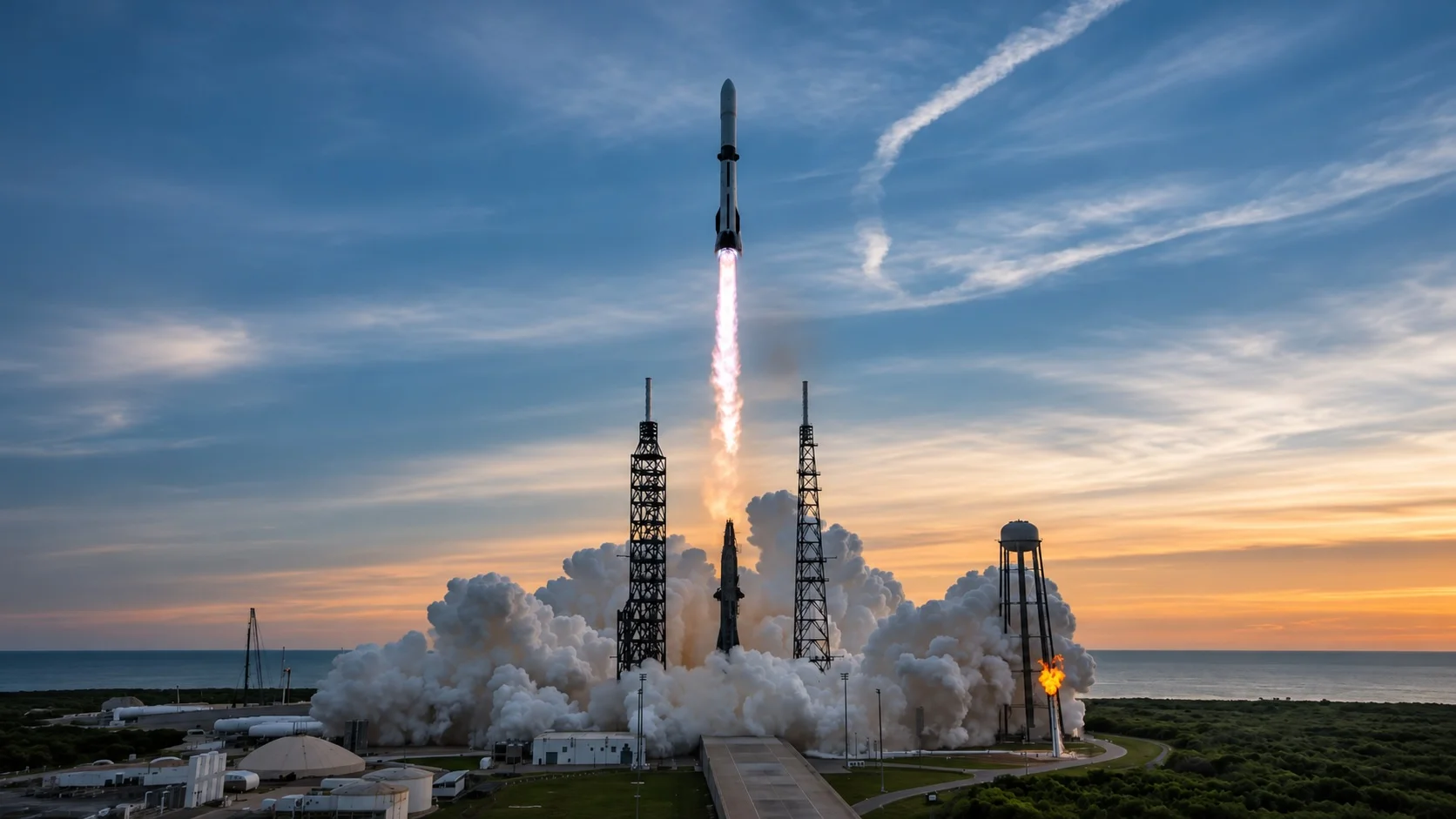
Google has signed a deal with Blue Origin to fly Project Suncatcher satellites on New Glenn. The mission, announced Nov. 19, is targeted for the first quarter of 2029 and would be the project’s first dedicated heavy lift launch.
The agreement, covered in The Rundown on Nov. 20, advances Google’s plan to run AI chips on solar power in orbit. The satellites would carry Google’s custom Tensor Processing Units, or TPUs. Google says each satellite is designed to pack roughly the computing power of a data center rack.
An early test in orbit
Google’s first prototype launched on Oct. 1, 2026 aboard SpaceX’s Transporter-18 mission. Planet built the satellite, and Google reported making contact after launch.
On Oct. 30, the company said an onboard Gemma 4 model had generated a requested haiku, which the satellite sent to Earth during a pass near Svalbard, Norway. Heat and radiation tests would continue, with two interconnected satellites planned for 2027.
Why it matters
AI data centers add to demand for electricity, land and water. In its 2026 environmental report, Google said its total electricity consumption rose 37% in 2025 and its data centers consumed 10.523 billion gallons of water. Both figures include activity beyond AI. The company also acknowledges that data centers can affect local watersheds.
For utilities and communities near data centers, moving some computing into orbit could avoid some additional demand on Earth. How much pressure that could take off local infrastructure remains an open question. Any benefit depends on satellites delivering useful computing reliably, at a cost that makes them a practical option.
Google expects almost constant sunlight in its planned orbit. The chips would still produce concentrated heat, and a vacuum offers no airflow to carry it away. The system must move that heat from the chips to radiators, which release it into space. Google has tested cooling hardware in a vacuum chamber. The coming missions must show how it handles sustained computing in orbit.
Hardware failures create another constraint. Google’s research preprint says routine replacement of failed TPUs is impractical in orbit and proposes backup hardware as one response. The practical question is how much computing the satellites can deliver over their lives, including when parts fail.
The economics depend on more than the electricity supply. The same paper projects that launch prices could fall below roughly $200 per kilogram around 2035, assuming sustained price declines and substantial launch activity. It compares annualized launch costs with electricity spending at data centers on Earth. That calculation covers only part of the bill. Cooling equipment, hardware reliability and replacement needs also affect the cost of useful computing.
A larger fleet would tie the communications challenge to orbital safety. Google’s proposed clusters would place satellites close together for fast laser links. That design requires precise positioning, collision avoidance and plans to handle debris. The planned 2027 test with two connected satellites could help show how well the links work in orbit. A larger fleet would have to keep those connections stable while operating safely around other spacecraft.
Sources & further reading
- 01therundown.ai ↗
- 02Google partners with Blue Origin on Project Suncatcher heavy-lift launch ↗
- 03Google's Project Suncatcher prototype satellite is in orbit ↗
- 04Google receives response from Project Suncatcher prototype satellite in space ↗
- 05Learn about Google’s Project Suncatcher to put ML infrastructure in space ↗
- 06Towards a future space-based, highly scalable AI infrastructure system design ↗
- 07Google 2026 Environmental Report - Google Sustainability ↗
This story builds on reporting from The Rundown newsletter on November 20, 2026.