Figure bets on up to 100,000 GPUs to scale its humanoid AI
Figure’s Nscale deal targets up to 100,000 GPUs for Helix, pairing a major compute commitment with human task videos. The robot scaling bet remains unproven.
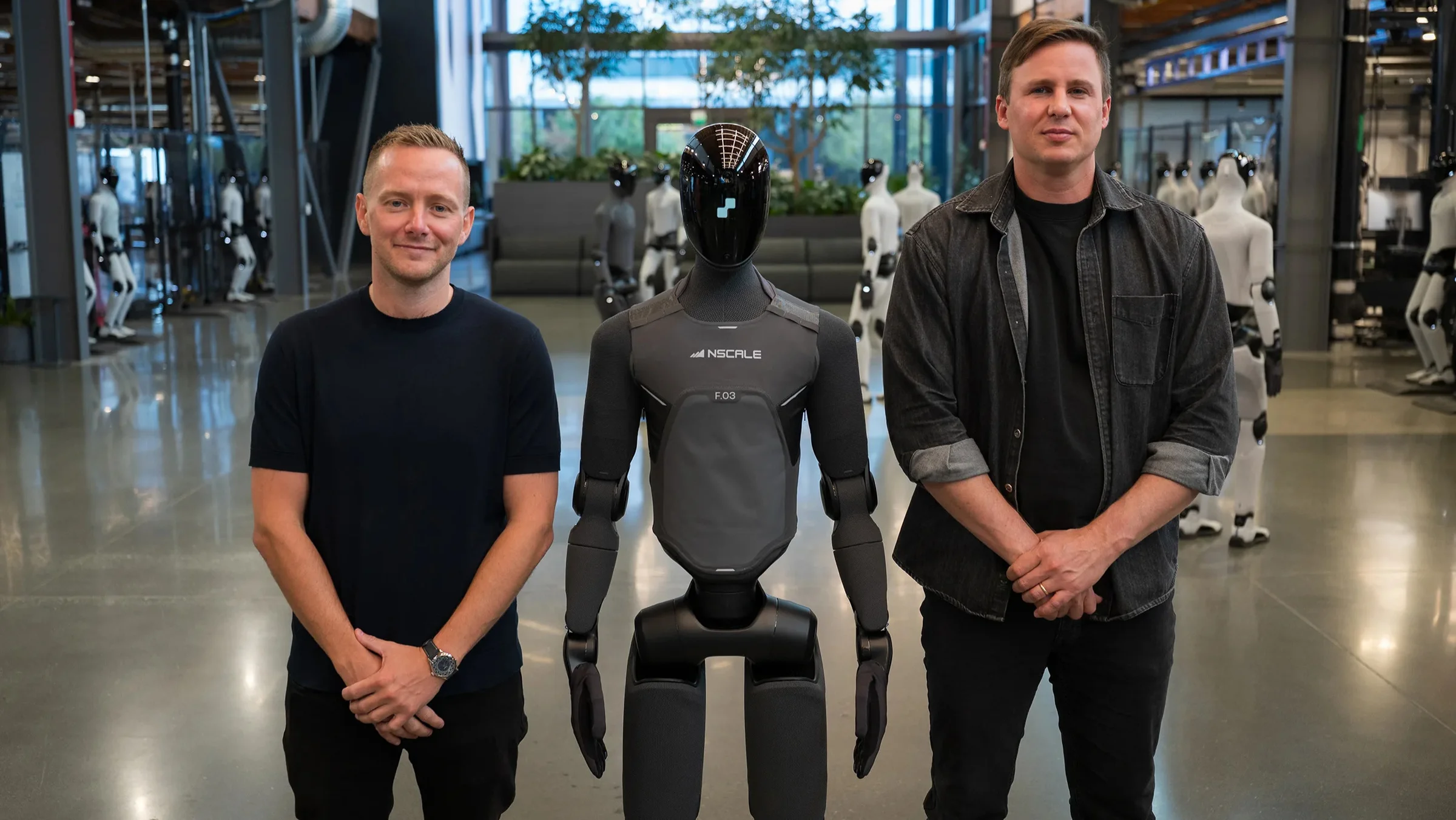
Figure has announced a deal with UK compute provider Nscale for access to up to 100,000 GPUs on Nvidia’s Vera Rubin platform to train Helix, the AI behind its humanoid robots. The partnership pairs a large compute commitment with Figure’s effort to collect human task videos, betting that more of both will help robots work in factories and homes.
The agreement was announced September 3 and covered in The Rundown’s September 7 newsletter. Figure targets initial deployment of the chips in Barstow, Texas, in the second half of 2027. That leaves a substantial wait before this new capacity starts arriving, with the eventual gains in robot capability still to be demonstrated.
What Figure has committed
According to Figure’s announcement, the deal includes an initial compute commitment of $3.5 billion and an intent to scale beyond $6 billion. The companies have not disclosed the initial GPU tranche or a full deployment schedule. The headline allocation describes the agreement’s potential scale.
Nscale says the agreement spans multiple years and will make it Figure’s preferred compute provider and a shareholder. The companies also plan to explore putting humanoids to work in Nscale’s supply chain. That exploration could give the partnership an operational dimension, although no robot order or deployment was announced.
The second half of 2027 means July through December, roughly 10 to 16 months after the newsletter issue. Initial chip availability is one milestone in a longer process that includes training, evaluation, and eventual deployment of improved robots. The announcements do not establish when customers will see those improvements.
The data effort alongside the chips
Figure has identified both compute and data as constraints on Helix. Its answer on data is Index, an app that pays people to record household and workplace tasks.
In its August 25 Index announcement, Figure reported more than 16 million uploaded videos, 264,000 app downloads, participation across 108 countries, and $15 million paid to contributors. Those figures describe collection activity reported by the company.
Figure also described filtering, fraud review, deduplication, rebalancing, and annotation. Those steps matter because a large collection has to become useful training material. Figure said internal generalization results supported its approach, while leaving quantitative evaluation details for a later release.
Why it matters
Figure is making a coordinated bet that more data and more compute can move Helix toward useful work across factories and homes. Addressing both constraints together gives the strategy a clear logic. A larger training system needs useful examples, and a growing collection needs enough compute to turn those examples into better behavior. The financial commitment shows how heavily Figure is investing in that possibility.
For prospective industrial customers and households, the practical payoff would be robots that can handle a broader range of tasks and unfamiliar situations reliably. The announced GPU count cannot establish that payoff. The commitment creates a long lead time and a large financial exposure while the relationship between training scale and general physical capability remains uncertain.
There is encouraging evidence that some robotic skills improve with scale. Research by Fanqi Lin and colleagues, involving more than 40,000 demonstrations and 15,000 robot rollouts, found approximately power law improvements as environment and object diversity increased. Additional demonstrations within a fixed setting eventually contributed little. The study concerns bounded manipulation tasks, so its results offer limited support for a much broader humanoid strategy.
That finding makes the composition of Index’s collection important. Recordings spanning different objects and environments could help broaden what Helix learns, provided Figure can turn them into useful robot training. Filtering and rebalancing are central to that effort. A rising video count alone gives little indication of how well a robot will perform an unfamiliar chore.
The transfer from human recordings to robot actions also needs evidence. Figure’s original Helix announcement in February 2025 described roughly 500 hours of teleoperated robot demonstrations. Index expands collection through people performing tasks. Controlled comparisons showing better robot success, broader task coverage, or reduced demand for robot demonstrations would help establish what this new data contributes.
Practical performance brings another test. The original Helix architecture ran inference onboard the robot and included a fast action control component. More cloud training capacity could improve the models, but reliable execution and safe task completion still need evaluation on the machines themselves.
The next milestones therefore extend beyond chip delivery. Figure needs to show that its collection improves learning, that larger training runs produce meaningful capability gains, and that those gains carry into factory and household tasks. Physical intelligence may benefit substantially from scaling. Whether it can follow the trajectory of large language models remains an open empirical question.
Sources & further reading
- 01therundown.ai ↗
- 02Figure and Nscale Sign Strategic Partnership For Up to 100,000 GPUs on the NVIDIA Vera Rubin Platform ↗
- 03Nscale and Figure Sign Strategic Partnership to Power the Next Generation of Physical AI | Nscale ↗
- 04Introducing Index: Building The World’s Largest and Most Diverse Physical Dataset ↗
- 05Helix: A Vision-Language-Action Model for Generalist Humanoid Control ↗
- 06[2410.18647] Data Scaling Laws in Imitation Learning for Robotic Manipulation ↗
This story builds on reporting from The Rundown newsletter on September 7, 2026.