Fable 5.1 restarts frontier competition with fewer interruptions and new cost tradeoffs
Anthropic’s Fable 5.1 addresses workflow interruptions and cost concerns as frontier competition resumes, with OpenAI’s Astra following days later.
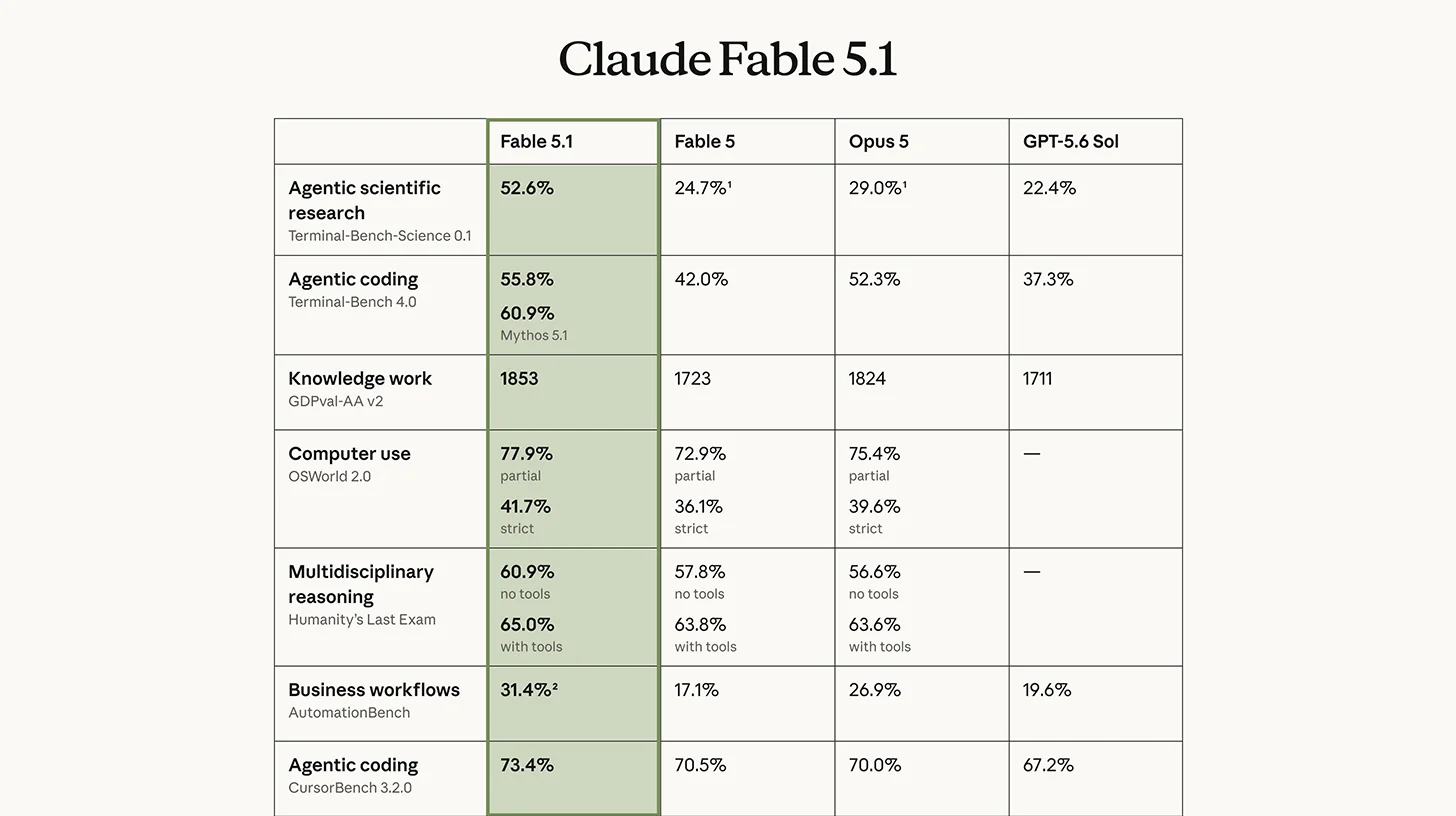
Anthropic released Claude Fable 5.1 with promises of stronger performance and fewer safeguard interruptions, addressing practical frustrations with Fable 5 as competition at the frontier picked up again. As reported in The Rundown’s September 2 newsletter, the launch put Anthropic ahead in this release sequence, with OpenAI signaling that Astra would arrive soon.
The upgrade’s appeal reaches beyond its leading benchmark score. Anthropic says it reduces interruptions to legitimate work and can lower costs under typical settings. Those improvements come with qualifications about effort levels, access restrictions, and safeguards still being developed.
What Fable 5.1 delivered
In its September 1 evaluation, Artificial Analysis reported an Intelligence Index score of 66 at maximum effort, up from Fable 5’s 62 and the highest result it had measured at publication. AA disclosed evaluation work with Anthropic before release and safety fallbacks that supplied roughly 4% of output tokens from Opus models.
Anthropic’s strongest research comparison was specific: on its Terminal-Bench-Science 0.1 evaluation, Fable 5.1 scored 52.6%, versus Fable 5’s 24.7%. That more than doubles the earlier result on this test; it does not establish a doubling of scientific research ability generally.
The gains also varied across evaluations. AA found the knowledge-work comparison with Opus 5 effectively tied or statistically overlapping, depending on the test. Its AA-Omniscience Index result stayed level with Fable 5 because greater accuracy was offset by more incorrect attempted answers.
Cost depends on the setting. Anthropic estimated 25% savings for token-billed workloads at default effort, based on four weeks of August activity. AA’s maximum-effort evaluation cost $3.76 per Index task, compared with $3.14 for Fable 5—about 20% more—with roughly 1.7 times as many output tokens. At the lower “xhigh” setting, Fable 5.1 scored 65 for $2.72 per task, according to AA’s evaluation.
More selective safeguards
Anthropic reported a 60% reduction in average cyber-safeguard interventions per Claude Code session compared with the previous Fable 5 safeguards. It also reported an 85% reduction in interventions on benign elementary-biology and medical requests. That second improvement applies to both Fable 5 and 5.1.
Restrictions remain consequential for specialist work. Penetration testing, exploit generation, and vulnerability scanning involving binaries still trigger routing to Opus. Anthropic also announced Mythos 5.1, the same underlying model with more permissive domain safeguards, for selected U.S. organizations. Initial life-sciences participants were enrolled, while broader inclusion in the cybersecurity program was forthcoming.
The competition has already moved
At the September 2 issue cutoff, OpenAI’s public commitment was that Astra would arrive “soon.” The company said it had delayed parts of development and release to strengthen safeguards, including a two-week pause in certain frontier training.
Update, September 3: OpenAI released GPT-6 Astra. On September 4, AA revised its Intelligence Index, changing tests, weighting, and grading infrastructure. It reported Fable 5.1 still leading, followed by Astra. The launch score of 66 belongs to the September 1 evaluation and should be read separately from the revised Index.
Why it matters
Fable 5.1 gives substance to the return of frontier competition after a period when security concerns dominated attention. OpenAI’s disclosed development pauses show how safeguards slowed its path to release. Anthropic moved first in this sequence with changes aimed at making demanding work easier to complete. Astra’s subsequent arrival gives that effort immediate competitive urgency.
For developers and researchers, fewer unnecessary interventions could make longer tasks easier to finish. A defensive security investigation can lose value if the model repeatedly interrupts legitimate work. Anthropic’s reported reductions therefore address a practical frustration, though their benefit will depend on the task and the safeguards it encounters. Restricted Mythos access also means specialists cannot assume the more permissive option is available to them.
Enterprise adoption faces a related obstacle: data handling. In its September 1 safeguards announcement, Anthropic acknowledged that Fable 5’s 30-day retention requirement made adoption difficult for many enterprises, particularly regulated ones. Its proposed Enterprise Frontier Safeguards would store data in customer-controlled infrastructure and send flagged activity to customers for review. A phased rollout was planned for later in fall 2026, with eligible customers offered zero data retention on Fable 5 and 5.1 in the meantime. Those concessions could reopen evaluations blocked by retention requirements; compliance would still require each organization’s assessment.
The cost results make effort selection a concrete buying decision. Teams should compare representative tasks at several settings and measure whether the added computation improves completed work enough to justify the bill. AA’s near-maximum score at xhigh suggests that the most expensive setting may offer limited extra value for some workloads.
The next competitive test is how reliably these models finish legitimate work. OpenAI warned before Astra’s release that safeguards could interrupt long tasks, including stopping API tasks when its misalignment monitor intervenes. That makes completion rates, interruptions, and cost important comparison points alongside benchmark scores. Anthropic’s changes target those concerns, but the launch evidence does not establish which model will handle a particular workflow better.
Sources & further reading
- 01therundown.ai ↗
- 02Introducing Claude Fable 5.1 and Claude Mythos 5.1 \ Anthropic ↗
- 03Claude Fable 5.1 tops the Artificial Analysis Intelligence Index | Artificial Analysis ↗
- 04Path to Astra: critical capabilities and frontier safeguards | OpenAI ↗
- 05Developing Enterprise Frontier Safeguards with our customers \ Anthropic ↗
- 06Safety overview: GPT-6 Astra | OpenAI ↗
- 07Announcing Artificial Analysis Intelligence Index v4.2 | Artificial Analysis ↗
This story builds on reporting from The Rundown newsletter on September 2, 2026.