Deep Venture robot could make deep ocean research easier and cheaper
Deep Venture, developed by WHOI and NASA’s JPL, is rated to dive nearly seven miles. Its promise is simpler ocean research, with cost savings still unproven.
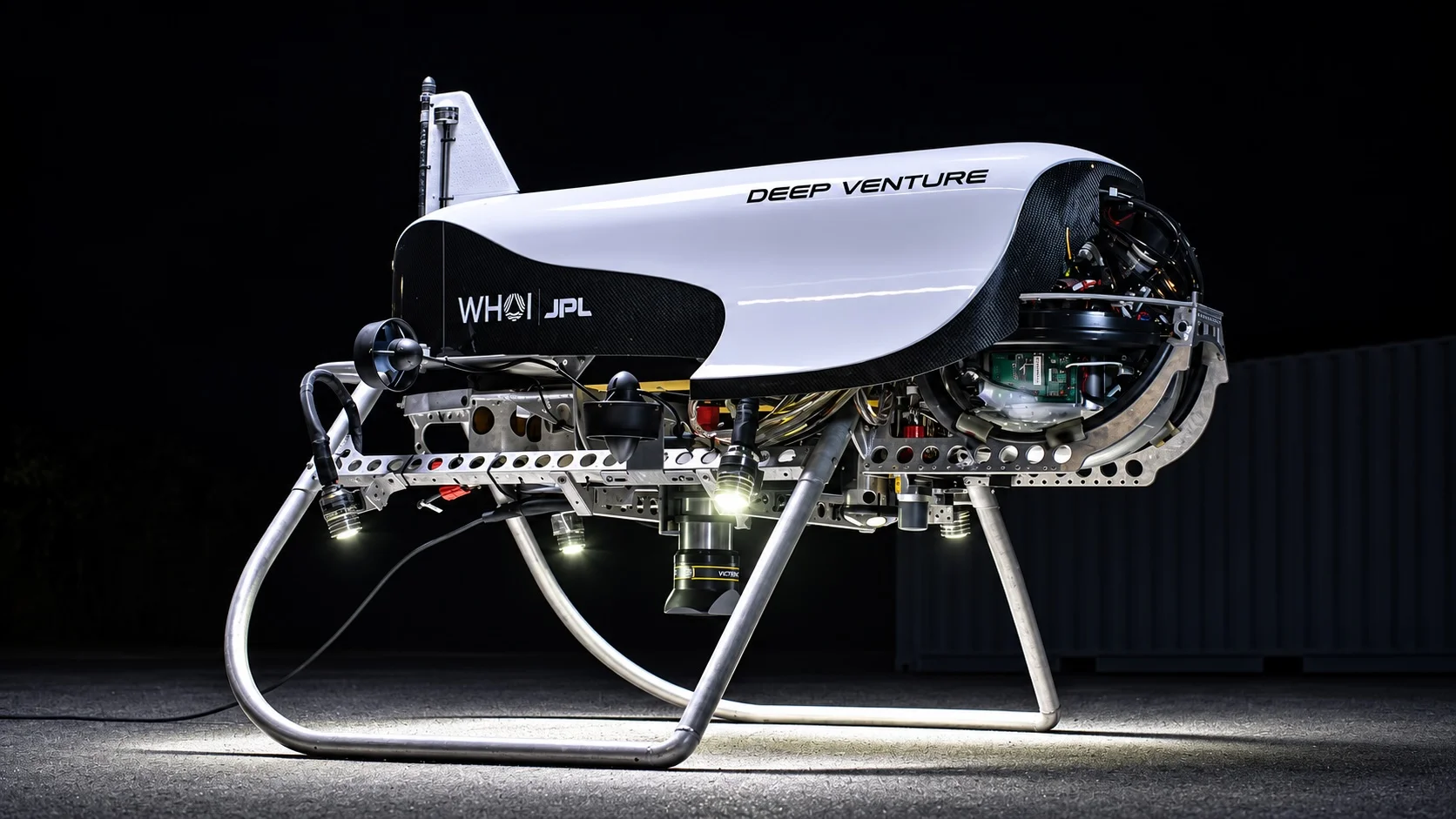
Woods Hole Oceanographic Institution released details of Deep Venture on Nov. 20. Developed with NASA’s Jet Propulsion Laboratory, the autonomous underwater robot weighs 250 kg (550 lb.) and is rated for depths of 11,000 meters, nearly seven miles.
The robot, featured in The Rundown on Nov. 23, can launch from a wide range of research ships and operate without a tether, WHOI says. Those features could make expeditions to the deepest ocean trenches easier to organize.
What Deep Venture can do
WHOI says Deep Venture can take detailed images and produce 3D seafloor maps. It can also land on the bottom and collect scientific samples. Researchers can change its instruments to suit different missions.
WHOI had described tests with its crewed submersible Alvin on July 1. During a June deployment near Bermuda, Deep Venture reached about 6,000 meters and gathered images to help Alvin’s crew choose dive sites, the institution reports. Performance at its full rating of 11,000 meters remains an open question.
Why it matters
Deep Venture joins a small, growing group of robots designed to explore the ocean’s deepest trenches, including China’s Haidou-1. In a 2023 paper, Haidou-1’s developers reported exploration and sampling below 10,000 meters in 2020 and 2021. They also described autonomous surveys without a tether as well as tethered operations.
Deep Venture’s potential breakthrough lies in making that work simpler, cheaper and more accessible to scientists. As of Nov. 24, WHOI’s project page describes operation by small teams from ships with modest deck space. That could let researchers fit surveys onto a wider range of cruises and reduce the support needed for each deployment.
The Alvin pairing shows how the robot could help scientists get more from a crewed mission. WHOI says advance images and environmental measurements help researchers select promising sites and pilots plan dives. A crew arriving with those targets could spend more of its limited time on the bottom observing and sampling. WHOI’s account does not quantify the time saved or any increase in samples collected.
Interchangeable sensors and samplers could broaden the vehicle’s role across research groups. A common platform could support different projects and reduce the need to commission separate vehicles. Any savings would depend on which instruments fit, how much the robot can carry and the cost of adding new equipment.
Reliability will also shape access. WHOI’s earlier robot Nereus reached Challenger Deep in 2009, then was lost at 9,990 meters in May 2014, probably after an implosion, according to the institution. Deep Venture’s reliability at its full rated depth will matter for researchers planning repeated surveys.
WHOI also claims reduced operating costs, though its project page gives no prices, comparative budget or measured savings. Researchers considering a mission face open questions about the expedition’s cost and how they could book the vehicle.
Sources & further reading
- 01therundown.ai ↗
- 02Deep Venture: A new class of ocean exploration vehicle | Woods Hole Oceanographic Institution ↗
- 03Human-occupied submersible Alvin certified to return to service | Woods Hole Oceanographic Institution ↗
- 04Front. Eng. Manag. 2023, 10(3): 546–549 ↗
- 05Deep Venture | Woods Hole Oceanographic Institution ↗
- 06FAQ: Nereus | Woods Hole Oceanographic Institution ↗
This story builds on reporting from The Rundown newsletter on November 23, 2026.