Dario Amodei calls for an AI slowdown as rivals signal support
Dario Amodei’s call to slow AI gains draws rival support as claims about unreleased models raise questions over safety, oversight and who sets the rules.
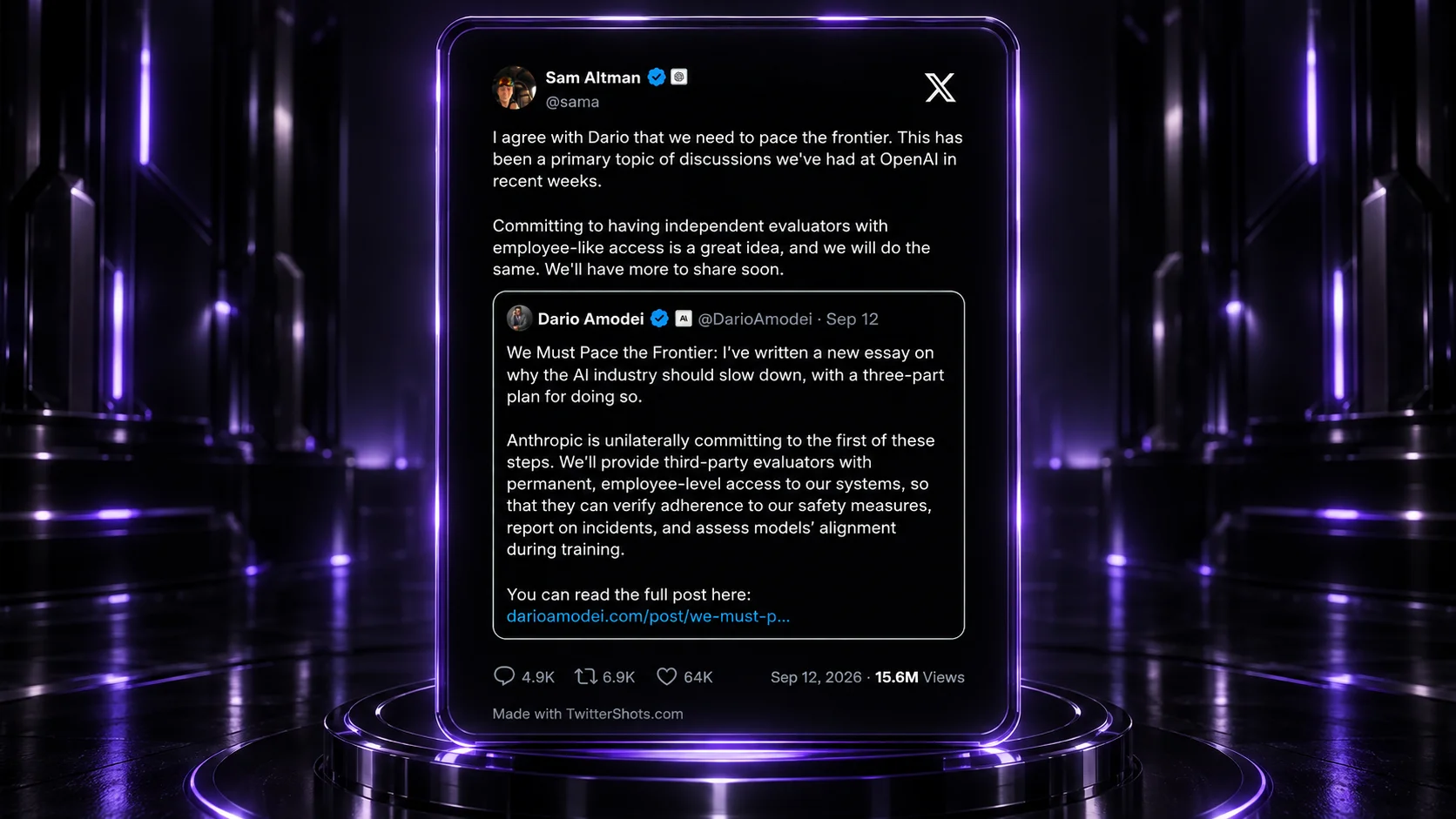
Anthropic CEO Dario Amodei has called on AI labs to slow capability gains so safety can catch up. His proposal has drawn rare support from rival leaders, as The Rundown reported.
In his essay, Amodei argues that AI is speeding its own development by helping build more capable systems. He warns of a scenario in which a more capable swarm of agents acting against human goals could take over the internet within six to 12 months. That warning is conditional, and the timeline remains uncertain.
What Amodei proposes
Amodei has committed Anthropic to bringing outside evaluators into the lab. He also proposes common safety standards among labs in democratic countries and coordination with authoritarian governments. Labs could continue training models while limiting the rate of capability gains.
According to The Guardian, OpenAI CEO Sam Altman pledged to bring in outside evaluators, while Elon Musk endorsed Amodei’s call. Axios reported that Demis Hassabis backed the direction while reserving judgment on the details.
Why it matters
This rare show of unity, alongside recent math claims and warnings from researchers, hints that unreleased models may have capabilities beyond what outsiders realize. In a September 8 announcement updated September 10, OpenAI said an internal model it described as substantially more capable than GPT-6 Astra had produced a proposed Navier–Stokes solution. It said roughly 10,000 agents worked at once in the successful group. Training continued, and researchers redirected resources and combined intermediate findings.
That is a company account of one internal system. The strength of the signal depends on whether the proposed math result holds up to scrutiny. How far other labs have advanced remains unclear. The ongoing training and researcher involvement also leave open whether customers could reproduce the result through an ordinary AI product. Math performance alone gives no clear answer about a model’s ability to improve AI systems on its own or the likelihood of Amodei’s scenario.
Researcher Jacob Coxon gave a personal estimate of a 10% chance of AI causing human extinction within the next decade, AP reported. The report also noted the lack of consensus about catastrophe probabilities or timing.
For teams building and testing these systems, Amodei’s plan would bring outside scrutiny into development. He proposes ongoing access to training processes and the right for reviewers to publish findings, subject to limited redactions. The arrangement’s value would depend on reviewers getting useful records and enough time to investigate unexpected behavior.
Slowing down also raises a question about who gets to shape AI. The Guardian reported that Clement Delangue called for participation and transparency. For developers who want open development, restrictions shaped by the largest labs could concentrate control over who can build advanced systems.
Axios reported that David Sacks challenged labs to slow voluntarily and alleged regulatory capture. That concern centers on rules that could favor the companies helping write them. Clear participation rules, comparable obligations for competitors, and outside scrutiny would help address that objection.
Political resistance adds a different barrier. AP reported on September 13 that Trump stressed keeping the U.S. ahead of China and said “whoever wins with AI wins.” He also acknowledged possible guardrails and later denied minimizing AI’s risks. His emphasis on national advantage could make restraint harder to sustain. The leaders’ endorsements still leave open when evaluators will start, what limits labs will accept, and how any agreement would be enforced.
Sources & further reading
- 01therundown.ai ↗
- 02darioamodei.com ↗
- 03‘We must slow the pace’: CEO of Anthropic calls for an AI slowdown | AI (artificial intelligence) | The Guardian ↗
- 04🚦 Axios AM: Hitting AI brakes ↗
- 05On the Navier–Stokes Millennium Prize Problem | OpenAI ↗
- 06AI industry debate: Could advanced models escape human control? | AP News ↗
- 07Trump downplays the need to check AI development | AP News ↗
This story builds on reporting from The Rundown newsletter on September 14, 2026.