Claude helps investment researchers test scorpion antivenom ideas
Five investment researchers worked with Claude to test scorpion toxin binders on a $200,000 budget. The proteins’ ability to stop venom is unproven.
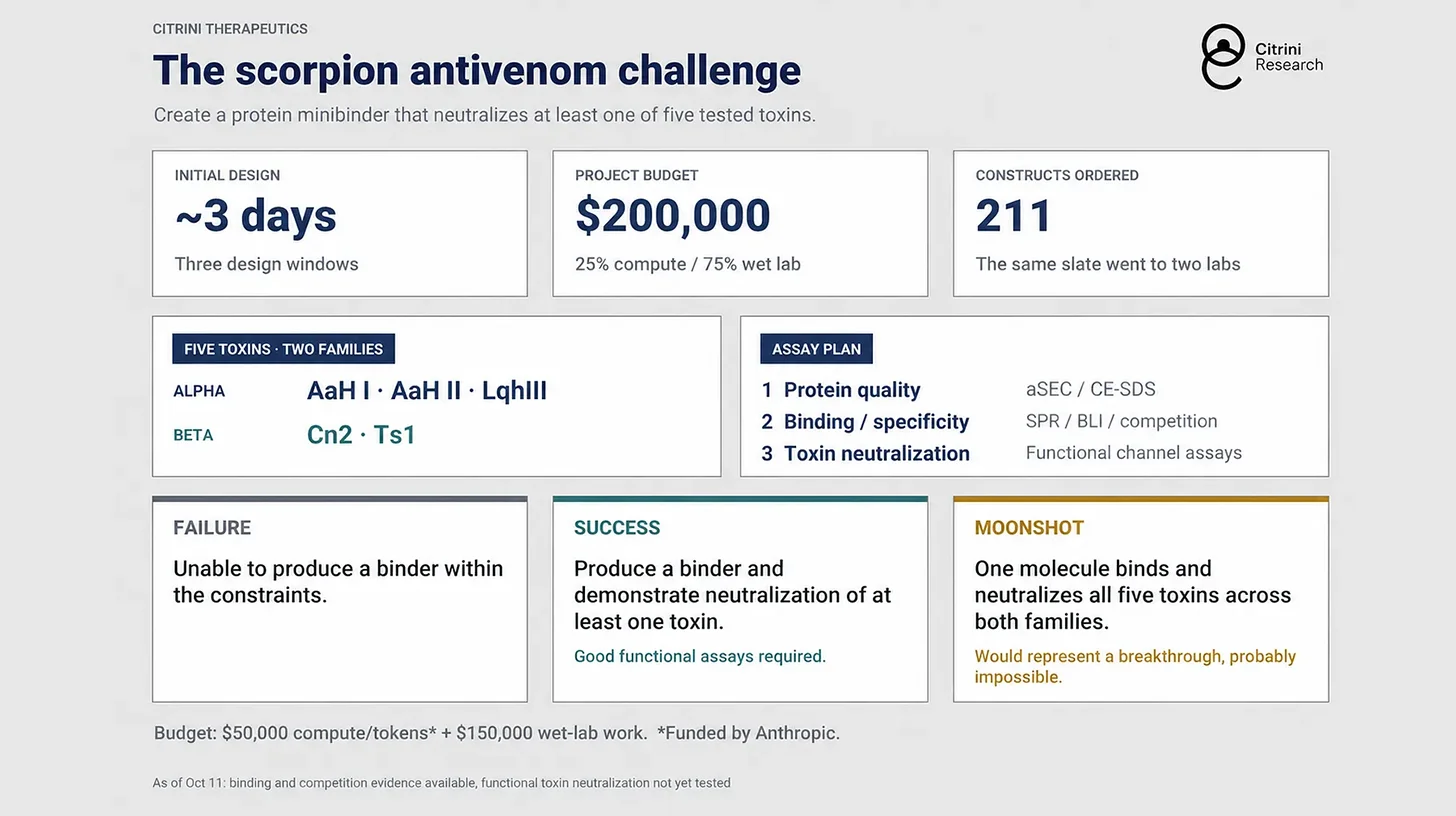
Anthropic published research on October 20 in which an internal version of Claude designed proteins that bind to scorpion toxins, a possible step toward antivenom. The company reported 17 qualifying binders from 211 designs sent for lab testing.
The experiment covered in The Rundown paired Claude with five staffers from investment research firm Citrini Research. Citrini says it worked with a budget of roughly $200,000. Three staffers had no science background; the other two had some, but neither was a veteran drug developer.
From designs to lab tests
Biosecurity restrictions first blocked Citrini’s work on its own computers. The team moved to Anthropic’s offices, where it worked with an internal model and got help from Anthropic staff on a prompt of about 35 pages.
Anthropic reports that Claude generated 318,484 candidates during a run lasting 64 hours, drawing on 12 specialist tools. Claude selected 180 designs; humans working with it added 31. The final 211 went to Twist Bioscience and Adaptyv Bio for testing. Citrini reports five human messages during that initial design run and 367 across the whole project.
Anthropic’s released data list 17 qualifying binders against four of five toxin targets. For two of those binders, only Adaptyv measured binding to the target toxin. Each of the 17 qualified against a single toxin.
Whether these proteins can stop the toxins’ effects in cells or protect animals remains untested. Citrini called its universal antivenom experiment a failure.
Why it matters
The key is who held the keyboard. Staffers at an investment newsletter with little drug development experience brought an idea through computer design and into physical testing. That suggests AI could broaden who starts research projects by helping them coordinate specialist tools and turn a question into candidates for experiments.
The support behind this project sets limits on that promise. Citrini needed Anthropic’s help and access to an internal model. Anthropic’s Life Sciences Verification Program, launched September 17, reviews research credentials, security standards and ethical oversight, and initially served teams and institutions. Access rules could shape who can carry out similar work.
In Anthropic’s own lab, announced in September, Claude helps form hypotheses and interpret results. Human scientists perform all laboratory work. For newcomers, access to scientists who can design sound tests and assess evidence could be as important as access to the model.
The budget shows where time and money went. Citrini reports $49,997 in compute costs, just under $150,000 in lab charges and a wait of roughly two months for experimental work. Its account leaves the full cost, including Anthropic’s staff time and any subsidized model access, unclear. If AI makes designs easier to generate, lab capacity and funding for tests could become more important constraints.
Better AI tools could reduce the computing needed for design work. In research published September 17, Anthropic said a simplified workflow reached similar predicted binding scores with about one hundredth of the GPU time required by earlier campaigns. Those comparisons measured computer predictions. Equivalent success in lab tests remains unproven.
Anthropic’s public dataset gives other researchers all 211 tested designs, predicted scores, experimental results and supporting files under CC BY 4.0. They can compare predictions with measurements, examine failures and choose candidates for tests of whether binding blocks a toxin’s effects.
Sources & further reading
- 01therundown.ai ↗
- 02How Claude designed protein binders against scorpion neurotoxins \ Anthropic ↗
- 03Citrini Therapeutics - Citrini Research ↗
- 04Anthropic/scorpion-toxin-binder-design · Datasets at Hugging Face ↗
- 05Introducing the Life Sciences Verification Program \ Anthropic ↗
- 06Claude discovers a novel enzyme system \ Anthropic ↗
- 07How Claude is uplifting biomolecular modeling \ Anthropic ↗
This story builds on reporting from The Rundown newsletter on October 21, 2026.