Bob McGrew’s Arda debuts at $1.5B with AI for factories
Former OpenAI research chief Bob McGrew’s Arda raised $160M at a $1.5B valuation to help factories turn new product designs into assembly plans.
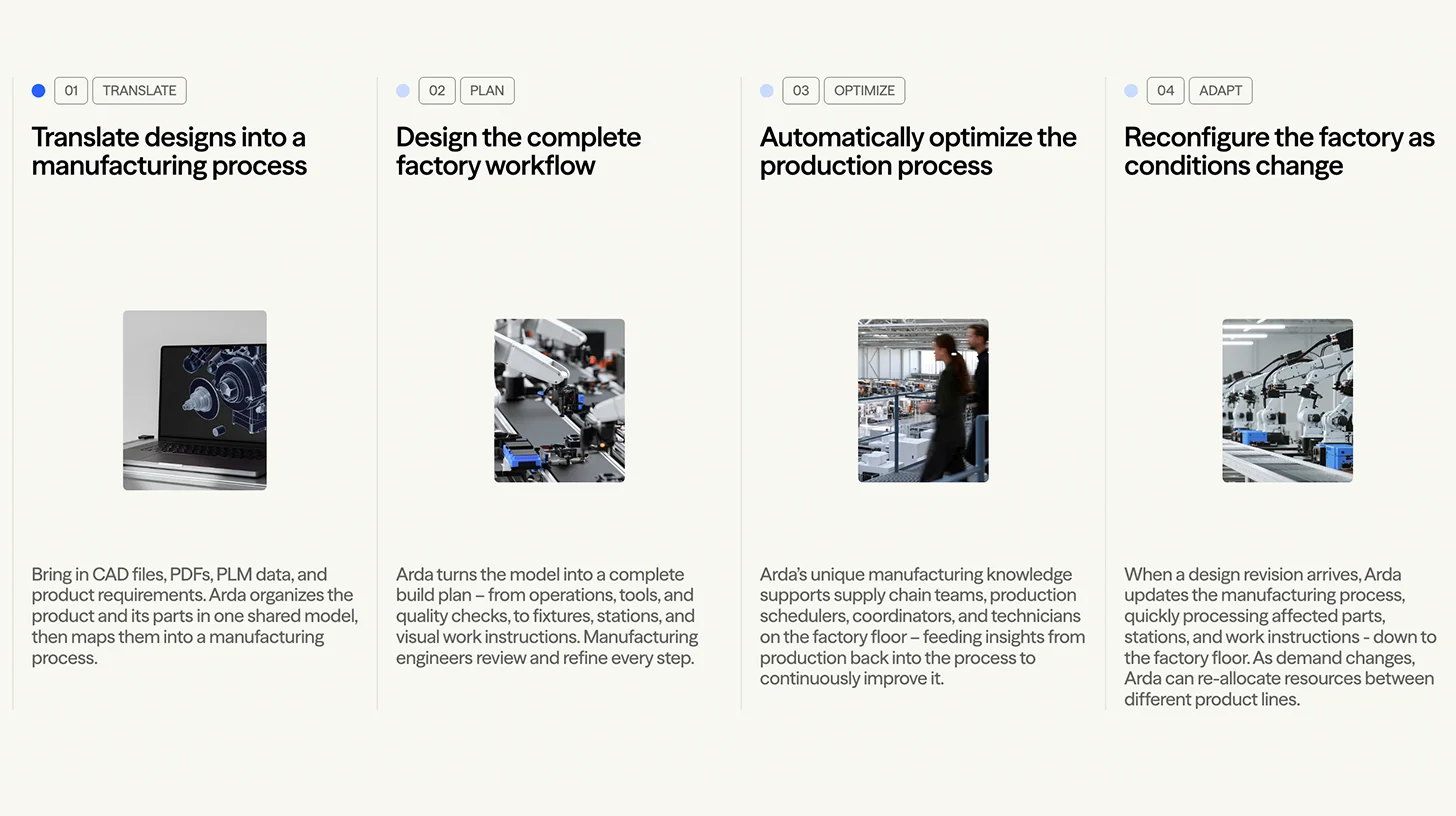
Former OpenAI Chief Research Officer Bob McGrew launched Arda on Oct. 20, bringing AI to the work of preparing factories to build new products. The startup emerged from stealth with a $160M Series A at a $1.5B valuation, as The Rundown reported.
The round brings Arda’s total funding to $232M, including a $72M seed round. Anduril, its first design partner and customer, has added Arda to its ArsenalOS system.
From product designs to assembly plans
Arda says its software derives assembly processes from design files and other product materials. The aim is to cut the work needed to turn those designs into instructions for building a product.
McGrew pitched it as doing “for manufacturing engineers what Claude or Cursor does for programmers” in a CNBC interview quoted by The Next Web.
Anduril says basic assembly instructions now take 15 minutes to produce, down from 10 hours. That gives Arda an early customer example of the engineering time its software could save.
Arda says conventional automation for a single station can take three to six months and cost nearly $1M, while people can learn revised instructions in a day. Its next goal is to make robots easier to reprogram. The company is prototyping robot programming, with the aim of updating automated lines in days.
Why it matters
McGrew joins Mira Murati and Ilya Sutskever among OpenAI alumni running startups worth billions. By July 15, Murati’s Thinking Machines had a $12B seed valuation and had released its first model, Inkling. Sutskever’s Safe Superintelligence reportedly reached a $32B valuation in April 2025. Arda brings a manufacturing focus to that group, applying AI to the steps required to get a product built.
In a June 11 interview with Semafor, Jeff Bezos said Prometheus had raised $12B at a $41B valuation to pursue an “artificial general engineer.” Prometheus’s ambitions cover engineering and manufacturing, giving it potential overlap with Arda’s assembly planning work. The announcement came about four months before Arda’s launch. Both companies have drawn substantial funding for AI aimed at physical products.
For manufacturing engineers, Arda’s immediate promise is fewer hours spent preparing and revising assembly plans. If the reported gains hold across customers, teams could handle more new products or respond faster to design changes.
The larger opportunity is reducing the cost of changing an automated line. If Arda can make repeated reprogramming cheaper and faster, products whose designs change often could become better candidates for automated production in the U.S. Manufacturers would need to weigh those savings against software prices and the work needed to fit Arda into their production systems.
The Anduril figures measure individual engineering tasks. Their effect on factory output, unit costs and delivery times remains uncertain. Judging that effect will require accounting for time spent reviewing plans and correcting any errors. Arda’s pricing, deployment scale and timetable for reprogramming automated lines in days also remain open questions.
Sources & further reading
- 01therundown.ai ↗
- 02Arda Emerges from Stealth to Speed Up American Manufacturing ↗
- 03Ex-OpenAI research chief Bob McGrew’s Arda raises $232M for US factories ↗
- 04Thinking Machines Lab Drops Its First Model | WIRED ↗
- 05OpenAI co-founder Ilya Sutskever’s Safe Superintelligence reportedly valued at $32B | TechCrunch ↗
- 06Jeff Bezos raises $12B for AI that builds things | Semafor ↗
This story builds on reporting from The Rundown newsletter on October 21, 2026.