Bedrock’s autonomous excavators target construction’s operator shortage
Bedrock’s autonomous excavators are working on infrastructure projects. They could ease operator shortages, but reliability and support needs remain open.
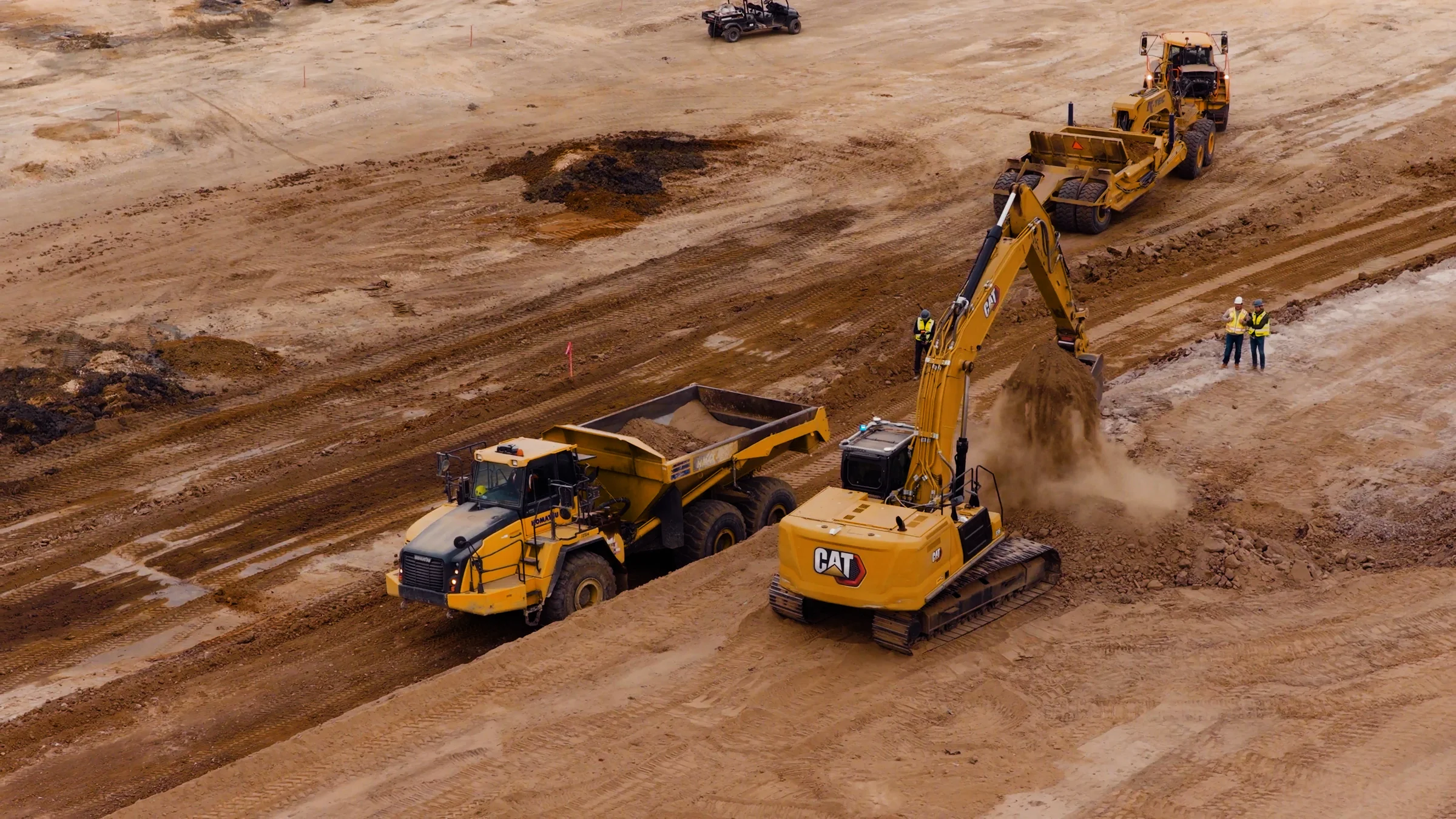
Bedrock Robotics has begun deploying excavators that dig without anyone in the cab on infrastructure projects in Texas and Nevada. As covered in The Rundown’s September 7 newsletter, the San Francisco startup says its first machines are already approaching human productivity on active construction sites.
That claim puts a practical question at the center of the rollout. Can autonomous excavation ease a shortage of experienced operators while delivering the dependable work that construction schedules require? The early deployments offer a place to test that promise, but their scale and duration leave reliability unresolved.
What the excavators are doing
In its August 17 announcement, Bedrock described deployments at a Nevada water treatment facility with Sundt Construction, a Texas project involving millions of cubic yards with Champion Site Prep, and a 1.2 million cubic yard project with Zachry. Those volumes describe the projects’ scope. Bedrock has yet to establish how much of that work its autonomous machines have completed.
The excavators are handling rough earthmoving. A Bedrock spokesperson told Fox News on September 6 that the company measures productivity in cubic yards per shift and that remote human intervention is rare. Both the productivity comparison and the intervention description come from the company; they have not been independently established.
Bedrock also says a machine automatically stops when a person gets too close and stays halted until the area clears, then resumes without a human restart. That describes a safeguard. Establishing its effectiveness requires evidence about detection, stopping behavior, and operation around people over time.
The company markets its system as a kit that can be installed on an existing machine in a day without permanent modifications. As of the September 7 issue, however, the equipment operating in these deployments consisted of new machines Bedrock had outfitted itself. Installation across contractors’ existing fleets remains a further test of the rollout.
Why it matters
Bedrock is aiming at a skills gap that takes years to close. The company estimates that excavators take five years or more to master. The Bureau of Labor Statistics describes several paths into equipment operation, including three- or four-year apprenticeships covering operation, maintenance, safety, grading plans, and positioning technology. Building that expertise requires a substantial investment of time.
Replacement pressure adds to the challenge. CPWR’s analysis of 2023 workforce data found that 23% of construction equipment operators were 55 or older. That age profile points to a need to develop future operators, though it cannot establish when individual workers will retire.
Labor constraints already affect project delivery. In a September 3 AGC and NCCER survey release, 42% of contractor respondents reported project delays caused by shortages among their own workers or subcontractors. The survey spans construction trades, so it cannot isolate the contribution of excavator shortages. It also found that 37% of respondents had reduced headcount by at least 5%, showing that hiring difficulty can coexist with uneven demand.
Earthwork gives autonomous machinery a potentially valuable role because clearing, excavation, and grading prepare a site for dependent construction phases. When that preparation slips, crews waiting for the site to be ready can face delays. If autonomous excavators can deliver steady, safe output, contractors could gain more predictable handoffs to the work that follows. Actual schedule savings still need to be demonstrated on projects.
For experienced operators and site managers, the useful measure would be how much work a crew can complete after accounting for supervision, maintenance, coordination, and remote assistance. An empty cab alone cannot establish that gain. The frequency and duration of interventions, along with the number of machines each support worker can oversee, would help show whether the system stretches scarce expertise further.
Dependability is the harder test. Equipment operators work in mud, dust, adverse weather, and remote locations, according to BLS. Results across those conditions and across tasks would be more useful to contractors than a single productivity average. Comparisons also need equivalent shift lengths, task difficulty, grading quality, and rework, alongside safety evidence such as operating hours, incidents, and near misses.
The retrofit promise could make adoption easier for contractors with existing equipment, but pricing, installation performance, and ongoing support costs will shape the decision. Bedrock’s first projects create an opportunity to demonstrate capacity relief. A handful of deployments cannot yet settle whether that relief will hold up across the varied conditions and schedules of infrastructure construction.
Sources & further reading
- 01therundown.ai ↗
- 02Bedrock Robotics Launches First Fully Autonomous Excavator ↗
- 03Bedrock Robotics deploys autonomous excavators with no operator onboard | Fox News ↗
- 04Construction Equipment Operators : Occupational Outlook Handbook: : U.S. Bureau of Labor Statistics ↗
- 05www.cpwr.com ↗
- 06Construction Workforce Shortages Remain Acute Despite ‘Soft’ Market Conditions As Data Centers Strain Labor Supply, Survey Finds | Associated General Contractors of America ↗
This story builds on reporting from The Rundown newsletter on September 7, 2026.