Apple Vision Pro enters hip surgery with Stryker’s FDA-authorized app
A Duke surgeon used Apple Vision Pro during hip surgery, showing how configurable surgical views could give the costly headset a practical medical role.
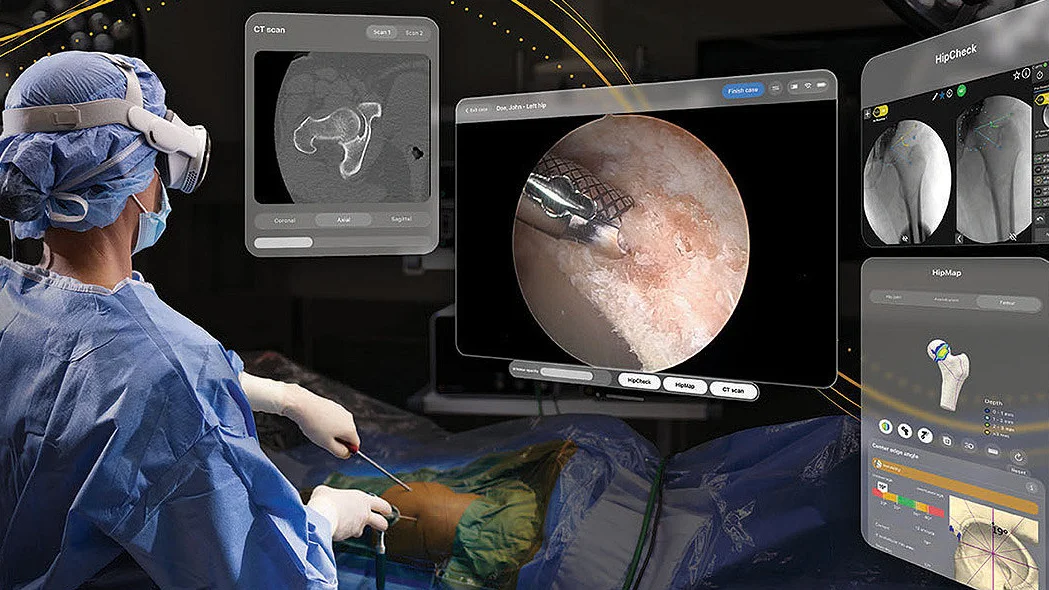
A Duke Health surgeon used Apple Vision Pro during hip arthroscopy to view live surgical video, CT images, and planning information inside the headset. The case gives Apple’s spatial computer a concrete medical application: putting several sources of information within a view the surgeon can arrange.
As covered in The Rundown’s September 4 newsletter, Stryker announced the procedure on September 1. The company says Duke orthopedic surgeon Chad Mather III completed the first hip arthroscopy using its SportSuite Vision app. The announcement does not specify when the operation took place.
What the surgeon could see
According to Stryker, SportSuite Vision brings together the live arthroscope feed, CT imaging, and information from its HipCheck and HipMap tools in a customizable visual environment.
That arrangement lets the surgeon position information to suit the procedure. Mather described being able to organize the views around his workflow. Stryker identifies him as a consultant, a relevant qualification when weighing his account of the experience.
The FDA’s July 17 De Novo order classifies SportSuite Vision Software as a Class II prescription device. Its indications cover intraoperative display during hip arthroscopy for femoroacetabular impingement and labral repair, including information presented by HipCheck and HipMap. Stryker calls it the first FDA-authorized application for intraoperative use with Vision Pro.
The authorization also defines how the headset fits into the room: the surgeon’s headset images must be used alongside traditional monitors used by other operating-room staff.
Other surgical applications were already emerging before the September 4 issue. In an April 27 announcement, SightMD said surgeon Eric Rosenberg had performed an initial cataract procedure with ScopeXR in October 2025, followed by hundreds of additional cases. Rosenberg co-developed that platform. The case volume is SightMD’s account; its announcement provides no independently verified total or comparative outcome data.
Why it matters
The Rundown’s original analysis framed Vision Pro as an expensive device still searching for a mass-market identity. Medicine offers a plausible source of purpose because it presents a specific information problem: surgeons need to consult several images and tools while operating. Bringing those sources into a configurable view could reduce how often they look toward screens positioned around the room.
The practical appeal starts with control over information placement. A surgeon could keep the live arthroscopy feed in a preferred position while making CT images and planning data available nearby. Stryker’s description supports that workflow possibility. Whether it measurably reduces distraction, fatigue, or operating time remains an open question.
For hospitals, this creates a focused purchasing question: does the arrangement help a surgical team enough to justify its cost and implementation? Apple lists a U.S. starting hardware price of $3,499. The complete cost of deploying SportSuite Vision in an operating room remains undisclosed, so that headline price alone cannot establish value for money.
Implementation also carries responsibilities for the wider surgical team. The FDA’s special controls address image latency and quality, usability, equipment compatibility, electrical safety, wireless coexistence, and reprocessing. In practice, hospitals would need to account for training, compatible equipment, and operating-room procedures. The requirement for staff monitors makes the surgeon’s personal view one part of a shared information setup.
The Duke case offers an early account of how that setup can work. Evidence of better patient outcomes or improved ergonomics would require comparative evaluation beyond a case announcement and consultant testimony. For clinicians and purchasing teams, measured workflow benefits and full system pricing would help determine whether the convenience warrants adoption.
Medicine could give Vision Pro meaningful specialist demand even while its broader consumer identity remains unsettled. The opportunity rests on a concrete task: making surgical information easier to place and consult. Whether that translates into routine hospital purchases, or a business large enough to alter the headset’s commercial trajectory, remains uncertain.
Sources & further reading
This story builds on reporting from The Rundown newsletter on September 4, 2026.