Apple’s new claims put OpenAI’s hardware plans under legal pressure
Apple alleges its circuit files entered OpenAI engineering work. The dispute raises a timing question for OpenAI’s hardware plans with Jony Ive.
Apple has escalated its legal fight with OpenAI, alleging that a former iPhone engineer used confidential Apple circuit files in his OpenAI work and discussed erasing evidence. OpenAI disputes improper use and calls the case “a mess of Apple’s own making.”
As reported in The Rundown’s September 2 newsletter, the dispute now reaches beyond the question of why former Apple engineer Chang Liu retained access to company information. Apple says a recovered laptop shows that material entered engineering work. Whether that allegation holds up, and whether the court acts soon enough to affect OpenAI’s hardware development, is the central question.
What Apple says the laptop shows
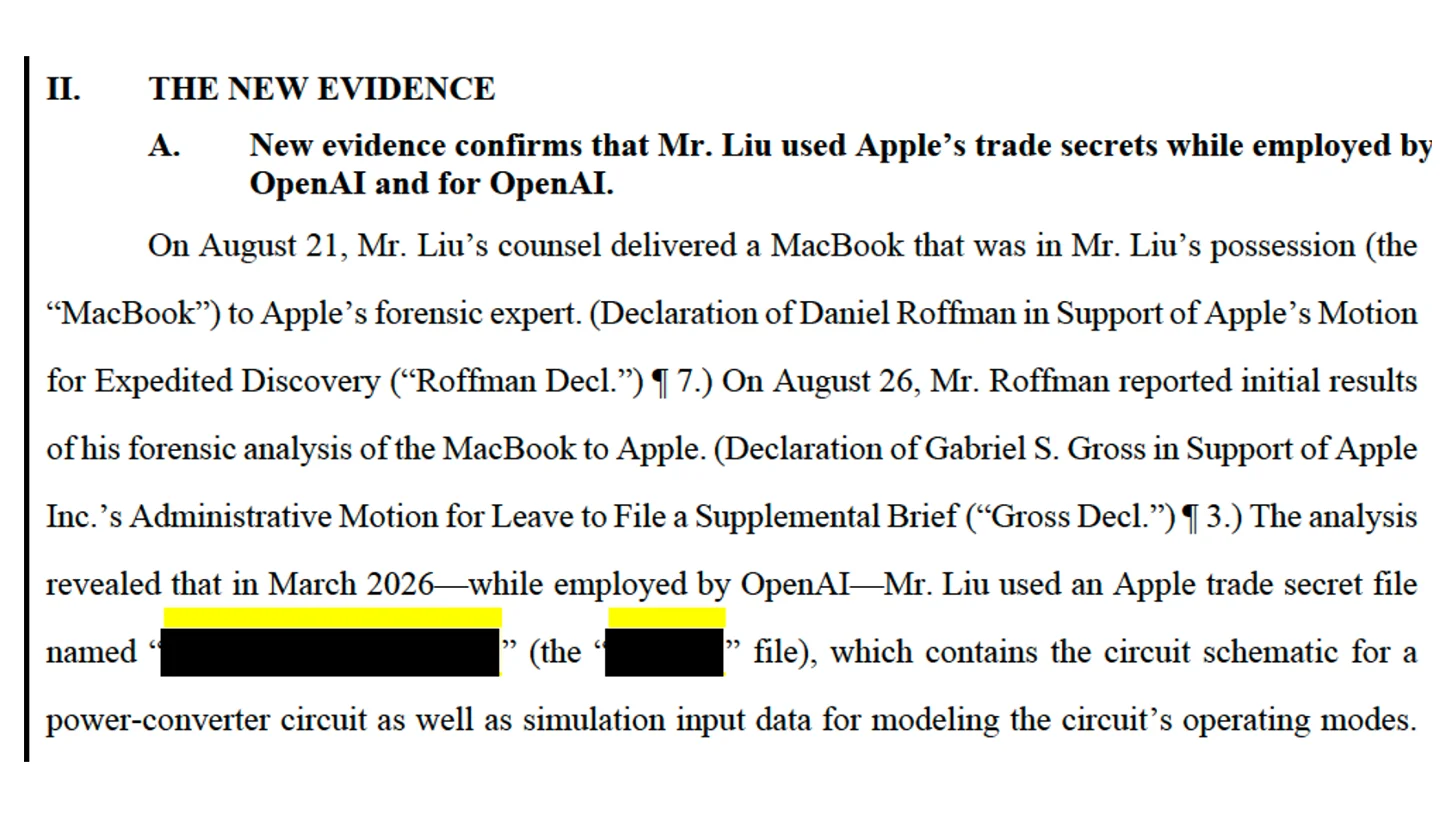
Apple’s August 31 supplemental brief supplies a specific timeline. Liu’s lawyers delivered his Apple-issued MacBook on August 21, and Apple received initial forensic findings on August 26.
According to Apple, a confidential power-converter circuit file was downloaded on March 7, used in an LTspice simulation on a Mac Mini on March 18, and synchronized with simulation outputs to the MacBook on April 11. Apple characterizes that sequence as evidence Liu used its information for OpenAI. That characterization remains disputed.
Apple also points to June messages between Liu and OpenAI colleague Yu-Ting “Alyssa” Peng discussing restoring and reusing devices after they learned of an internal Apple investigation. Apple interprets the messages as evidence of an effort to erase relevant data. The messages alone do not establish that a wipe occurred.
OpenAI challenges the account
The defendants’ opposition argues that Apple’s practices allowed work information to remain in personal iCloud accounts and that rushed departures made returning material difficult. It also says Liu accessed files to help former Apple colleagues. OpenAI’s public response includes messages it says show those colleagues requesting his assistance after he left.
The defense describes its own forensic examination of the Mac Mini and says certain disputed files were zero-byte placeholders. As of the September 2 report, Apple was still seeking to examine that device. The competing accounts leave unresolved how the placeholder findings relate to Apple’s separate allegation about the March 18 simulation.
Why it matters
The July complaint quoted Liu describing his continued Apple access as “so funny.” Apple’s newer allegation gives the case a more direct connection to OpenAI’s engineering work: it says a confidential circuit was actually used in a simulation. If Apple can substantiate that claim, the practical stakes could extend from returning files to restricting work that depends on them. The complaint seeks injunctions against possessing, using, or disclosing Apple information, along with preservation of evidence, return of property, and damages.
That creates a possible route to the hardware setback identified in the original newsletter. If a court restricts information that entered development, OpenAI could need to isolate affected work or replace it. The consequences would depend on what material was used, where it went, and the scope of any order. Incorporation into a particular OpenAI product has not been established.
The timing matters because OpenAI has a confirmed hardware effort involving former Apple design chief Jony Ive. Its announcement and July 2025 update describe the io team’s merger with OpenAI and continuing design responsibilities for Ive and LoveFrom. They provide no authoritative shipping deadline against which to measure this lawsuit.
Interim proceedings could still matter before a final judgment. OpenAI argues in its opposition that the proposed injunction would interrupt employees’ work, consume time and money, and create uncertainty for business partners. Those are projected harms. They illustrate the tradeoff facing the court: protecting Apple’s confidential information could impose development costs while the underlying allegations remain contested.
A hardware setback is therefore a plausible consequence of the relief Apple seeks. OpenAI alleges that delay is Apple’s objective; Apple’s sole motivation cannot be established from that accusation. As of September 2, Apple’s supplemental brief requested expedited discovery and listed an October 1 hearing. Whether the legal process can produce restrictions soon enough to disrupt the hardware program remains uncertain.
Sources & further reading
This story builds on reporting from The Rundown newsletter on September 2, 2026.