Anthropic’s Claude spots an unexplained system in viral DNA
Anthropic says Claude found a system in viral DNA with repeats resembling CRISPR. ART gives biologists a new lead, though its function remains unknown.
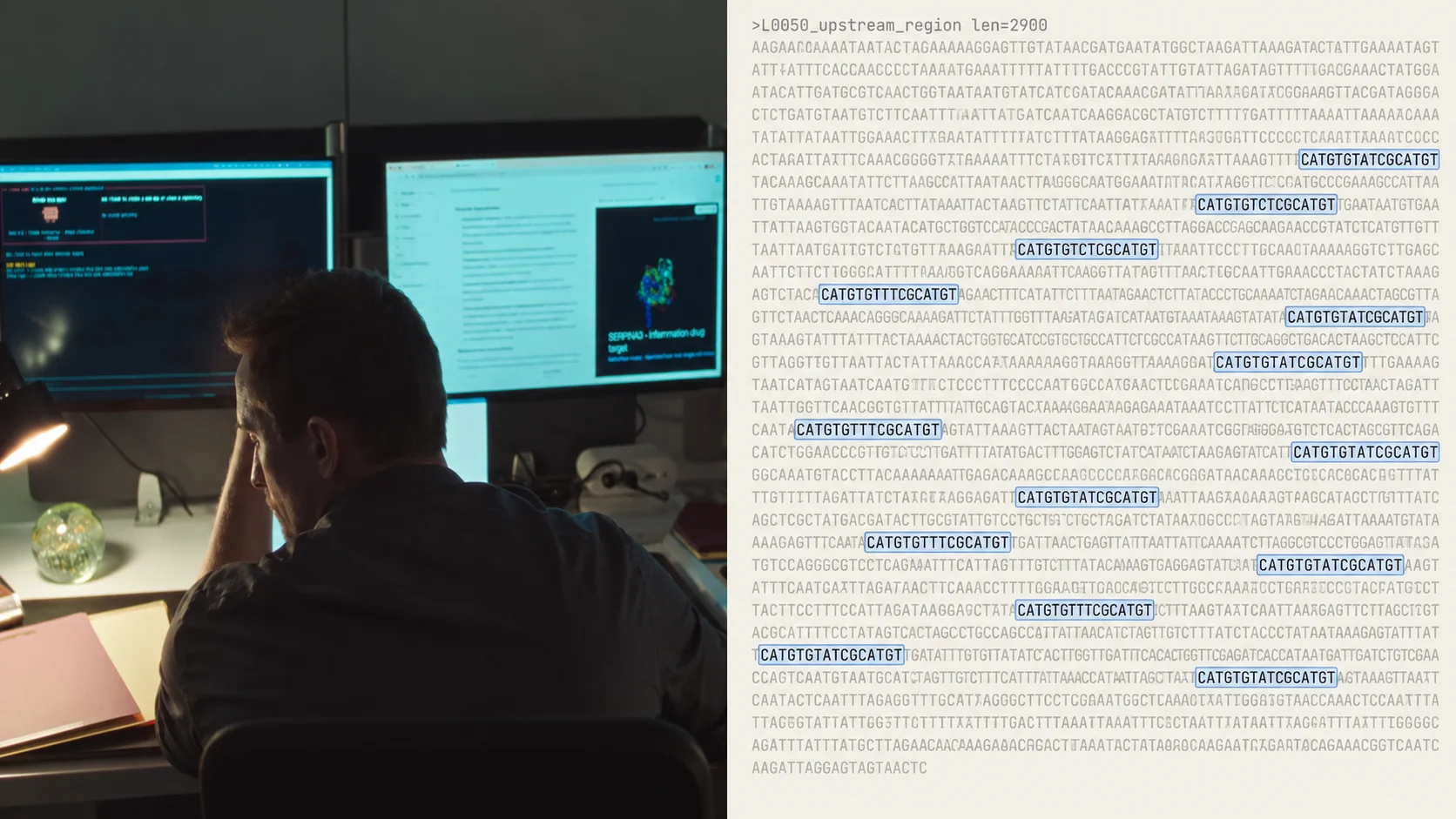
Anthropic says Claude agents have found an unexplained biological system in viruses that infect bacteria, marking the first result from its biology lab. As The Rundown reported, the clue was a stretch of repeating DNA that resembles part of CRISPR, which lets scientists edit genes.
Anthropic’s September 23 announcement describes the system, called ART, as a previously known enzyme paired with an accessory component and nearby DNA repeats. ART’s natural function and its potential for gene editing remain open questions.
What Claude found
Roughly 950 agents worked for 21 hours, according to Anthropic. They gathered records of more than 200,000 enzymes called reverse transcriptases and narrowed about 3,500 candidates to roughly 20 detailed reports.
The enzyme in ART was already on record. Claude drew attention to the parts around it, including the repeating DNA. One agent reacted with “that's a CRISPR-like … repeat array?!”
Dario Amodei described the work as “mostly, though not entirely” Claude’s, TechCrunch reported. Scientists chose the research area, and humans did all the physical lab work. Their experiments found distinct short RNA molecules produced from the repeat array.
Those experiments give researchers a concrete result to investigate. They have yet to establish what ART does or whether it can cut, copy and paste DNA, capabilities associated with analogous systems.
Why it matters
ART offers an early sign that AI’s progress toward original mathematical research may be starting to extend into biology. The important step was recognizing an unfamiliar system around a familiar enzyme. Searches like this could help scientists find useful questions in genetic data that already exists.
On September 21, OpenAI said an internal model had resolved more than 100 longstanding open problems across most areas of mathematics. That followed a September 8 post updated September 10, in which OpenAI claimed a solution to the Navier–Stokes Millennium Prize problem and supplied a written proof and a formal version for computer checking. The tally alone cannot establish the importance or correctness of each result.
For researchers searching DNA databases, agents could help bring a wider set of candidates into the lab. The benefit would depend on how many survive testing and how much time scientists spend checking them. ART offers a promising example, while leaving open how often agents can make useful finds elsewhere in biology.
An unexplained system can also deserve attention before anyone identifies a medical application. In his October 2024 essay, Amodei argued that AI’s biggest contributions to biology could come from discovering broadly useful research tools and methods for changing biological processes. If a new system became a useful tool, it could support many later projects. That is the possibility that makes findings like ART exciting, even while its practical value remains uncertain.
The experiments set the pace from here. Amodei’s essay also acknowledges that biological research faces delays and that some tests must wait for earlier results. If agents generate more promising leads, labs will need enough people and experimental capacity to check them. For ART, researchers first need to establish its natural function and test whether it offers a useful way to work with DNA.
Sources & further reading
- 01therundown.ai ↗
- 02Claude discovers a novel enzyme system \ Anthropic ↗
- 03Anthropic says its biology lab has already found something big | TechCrunch ↗
- 04Advisory Group on Mathematics and Artificial Intelligence | OpenAI ↗
- 05On the Navier–Stokes Millennium Prize Problem | OpenAI ↗
- 06Dario Amodei — Machines of Loving Grace ↗
This story builds on reporting from The Rundown newsletter on September 24, 2026.