a16z ranks AI app spending as companies push into personal agents
a16z’s latest AI app rankings add U.S. spending data, showing where people pay as Meta, OpenAI and xAI pursue personal agents for a broader audience.
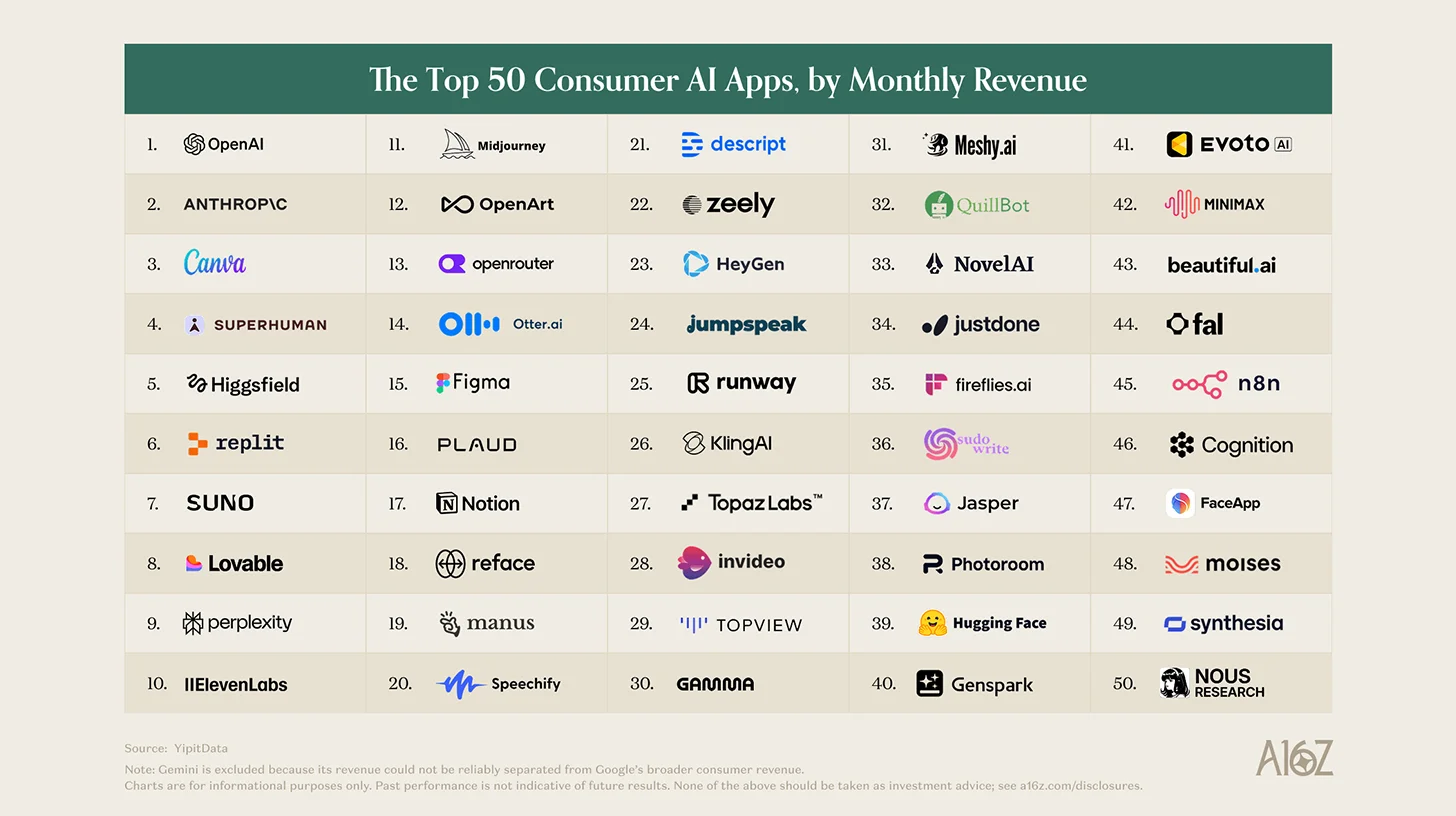
Andreessen Horowitz released the seventh edition of its Top 100 Gen AI Consumer Apps on October 5, 2026, adding a separate ranking of 50 vendors by observed U.S. consumer card spending.
The new spending list, covered by The Rundown, includes 29 vendors that appear on neither of a16z’s traffic lists. It adds another measure of demand as Meta, OpenAI and xAI push into personal agents.
Where the money goes
In the electronic receipt data cited by a16z, 4.5% of eligible U.S. panelists subscribed to ChatGPT, Gemini or Claude in August 2026. ChatGPT had roughly three times as many paid subscribers as either rival. Claude and Gemini were approaching parity after Claude moved ahead earlier in the year.
Spending was concentrated. The top 1% of tracked AI spenders averaged $903 a month and accounted for 19.5% of spending, exceeding the bottom half’s 16.6%. Their favored vendors included creative apps HeyGen and Higgsfield and builder tools Manus and n8n.
Among 44 web products built around AI, 84% offered subscriptions and 14% offered ads. Those percentages describe the business models available. They show how widespread subscriptions have become across this group of products.
Why it matters
a16z’s recurring list has become a useful tracker of AI’s changing product trends. Its first report found general chatbots drew 68% of traffic to the top 50 in June 2023, with creative tools already gaining ground. By the fifth edition in August 2025, coding products Lovable and Replit had entered the web ranking. Those shifts have overlapped as the rankings’ scope has changed.
With Meta, OpenAI and xAI now pursuing personal agents, the category looks like AI’s next serious chance at a mainstream breakout. Their promise extends to recurring chores, which could give people outside creative work and coding a reason to build AI into their routines.
OpenAI’s Dots announcement and xAI’s Grok Bot guide describe agents that can keep working on cloud computers connected to other apps. xAI says its bots can respond to schedules and events, and its examples include shopping comparisons. For a recurring shopping comparison, the value would come from getting useful options without rebuilding the request each time.
Access could help determine who tries them. Meta says Muse works through WhatsApp and its own app, keeps working after the app closes and is free for everyday activity, with subscriptions for heavier workloads. Its examples include booking travel and handling email. A familiar messaging interface and a free option could make trying an agent easier for people outside professional AI work.
OpenAI’s September 29 announcement put Dots’ initial rollout with eligible Pro and Business Premium subscribers, plus an Enterprise beta enabled by administrators. That starting audience leans toward paying users and organizations. The companies are pursuing the same broad opportunity through different routes to customers.
Delegating work also brings a supervision burden. Meta says sensitive actions require approval. OpenAI warns that Dots can make mistakes and that consequential work needs review. xAI’s guide describes human help with signing in and permission checks. An agent’s appeal will depend partly on whether it saves more effort than those checks require.
a16z reports that Muse passed 5 million downloads in under a month and describes agent activity as concentrated among power users. Downloads suggest early interest. Repeat delegation and reliable task completion would give a clearer view of whether agents are becoming a daily habit.
Sources & further reading
- 01therundown.ai ↗
- 02The Top 100 Gen AI Consumer Apps — 7th Edition | Andreessen Horowitz ↗
- 03How Are Consumers Using Generative AI? | Andreessen Horowitz ↗
- 04The Top 100 Gen AI Consumer Apps - 5th Edition | Andreessen Horowitz ↗
- 05Introducing dots | OpenAI ↗
- 06Grok Bot 101 · Grok Bot Guides ↗
- 07Introducing Muse: The World’s First Personal AI Agent Built for Everyone ↗
This story builds on reporting from The Rundown newsletter on October 6, 2026.