The AI bubble meets Anthropic’s real numbers
PLUS: Turn sales call notes into follow-up emails with AI


Good morning, AI enthusiasts, and welcome to our 5,851 new readers. The AI race in 2026 has been about more than just the best models… It’s also been about which top U.S. lab reaches Wall Street first. While OpenAI has backed off in that arena, Anthropic just opened the books with its official IPO filing.
What’s inside isn’t what many of the “AI bubble” critics predicted — a business growing far faster than it spends, and in typical Anthropic fashion, still openly voicing its concerns about what it’s building.
P.S. — Want a chance to be featured in The Rundown? Give GPT-6.1 Terra one real task this week and share how it went in the Workflow Hub by Friday, Oct. 30.
In today’s AI rundown:
Anthropic officially files to go public
OpenAI’s next batch of AI science discoveries arrives
Turn sales call notes into follow-up emails with AI
OpenAI’s new Terra cuts the cost of AI computer use
LATEST DEVELOPMENTS
ANTHROPIC

Image source: SEC.gov
The Rundown: Anthropic just filed its S-1 for a Nasdaq listing under the ticker ANT, giving investors a look at its finances, a unique ownership setup designed around its safety mission, and the risks it says come with building more capable AI.
The details:
Revenue hit $16.3B in the first six months of 2026, about 14x from a year earlier, and the June quarter alone turned a $974M operating profit.
Anthropic has raised $141B to date but still holds about $132B of it, meaning it has spent a net of roughly $9.4B to build a business that makes $11.6B a quarter.
All seven co-founders pledged 80% of their stakes to charity, and the board can give its Public Benefit Fund up to 2% more shares per 50% stock climb.
Claude wrote over 90% of Anthropic’s code in September, and staff’s Claude use, valued at retail prices, first passed monthly cash payroll in April.
A safety area of the filing also warned that some internal work run by Claude could grow “difficult for any individual or group of humans to understand and control.”
Why it matters: One of the loudest knocks on the AI boom was that the frontier labs’ businesses wouldn’t hold up. Anthropic just answered that with a profitable June quarter and nearly all the money it raised still in the bank. The debate now moves from whether the business works to what it’s actually worth, with ANT’s opening valuation still awaited.
TOGETHER WITH PAVE

The Rundown: Most AI builders stop at the prototype, leaving integrations and automation to a pile of other tools. Pave builds the app, workflows, and connectors in one account, so the process runs without the glue work.
Building with Pave offers:
350+ connectors on every plan, including Free
Workflows built on a visual canvas from plain language
Hosting, data model, and permissions
OPENAI & SCIENTIFIC DISCOVERY

Image source: OpenAI / Clay Mathematics Institute
The Rundown: OpenAI said its unreleased models made new discoveries in physics, math, and computer science, including part of a Millennium Prize problem and a disproof of a decades-old computing assumption, weeks after its massive 722-paper math drop.
The details:
In computer science, the models disproved the Exponential Time Hypothesis, a decades-old assumption that hundreds of papers rely on.
The scientists who first proposed the hypothesis are reviewing the claim, writing that if it holds, “it will change an important part of theoretical computer science.”
OAI says its models also proved a 35-year-old wave conjecture and part of a $1M Millennium Prize problem, with Nobel laureate David Gross leading the review.
The company says it does “not seek academic credit” for the results, and agreed to release all its raw data on the hypothesis so anyone can check the work.
Why it matters: Where Oct. 6’s math drop was about volume, this one is three results that are each famous on their own, with the main proofs computer-verified before the announcement. The prior release showed AI could churn out research by the hundreds, but today proves it can also crack the problems whole fields are organized around.
AI TRAINING

The Rundown: In this guide, you’ll try Inception’s new Mercury 3 to turn three sales call notes into follow-ups. You’ll check the prices and promises, change one customer’s needs, and compare the result with your usual model.
Step-by-step:
Open OpenRouter Chat and choose Inception’s Mercury 3. Check the usage cost and start a fresh conversation without connected accounts.
Paste the guide’s fictional product facts and three call notes. Ask for a plan recommendation and a short, unsent reply for each lead.
Check every recommendation against the offer. A plan that fits the team size can still miss a required feature, and a requested discount is not an approved one.
Change one lead from eight users to 18. Mercury should withdraw its earlier recommendation because the largest listed plan only covers 15 people.
Try the same task with your usual model. Compare mistakes, waiting, and time spent fixing the drafts before deciding which to keep.
Pro tip: Measure the time to a reply you would actually use. Fast text is less useful when it needs a long edit. You can get our test resources and prompts Visit The Rundown University.
PRESENTED BY VOXEL51

The Rundown: Should you prompt a Vision Language Model (VLM) or train a specialist to label data? One labeled example boosts defect classification F1 by 25 points, but 10 examples give specialists the edge.
What you’ll learn:
Teach VLMs domain-specific labels
When training justifies the cost
Few-shot prompting with Agentic Labeling
Read the findings and join the workshop with Nebius.
OPENAI

Image source: OpenAI
The Rundown: OpenAI just released GPT-6.1 Terra, an upgrade to its mid-tier model with a focus on computer use, speed, and efficiency — now live in ChatGPT and OAI’s Codex coding tool at half the API price of the GPT-5.6 version it replaces.
The details:
Terra finishes tasks over 3x faster than the pricier Astra and Sol, while tying Astra on computer use and nearly matching both on visual reasoning.
In OAI’s own testing, Terra cost roughly 1/9 as much per task as Anthropic’s Claude Opus 5.5, though Opus outscored it where the two were compared.
Despite costing half as much as its predecessor, Terra cut its hallucination rate in OAI’s testing from 53.6% to 16.7%, with other gains across the board.
OAI rated Terra’s cyber skills as “Critical” on its Preparedness Framework risk scale, and the model ships with the same safeguards built for GPT-6 Astra.
Why it matters: Terra is a solid upgrade that certainly cuts costs for quick, reliable work, but not one that is going to get the buzzy headlines, particularly with Anthropic’s models dominating the leaderboards. Claude’s weekly average token volume on OpenRouter is up 3.6x since Opus 5.5’s debut, and a cheaper mid-tier model is unlikely to change that.
QUICK HITS
COMMUNITY AI WORKFLOW OF THE DAY
▸ A Rundown reader built a reading app staffed by Claude Code agents
Today’s workflow comes from an anonymous Rundown reader:
“I wanted a reader for my own PDFs and EPUBs where I could write notes in the margin next to the line they belonged to. Nothing I tried did that well, so I built Helicon, a free reader for iPhone and iPad. I use it every day.
I do not write most of the code by hand. I run several Claude Code sessions, each with one responsibility. A development session builds the app in Swift. A marketing session reads the usage numbers and finds places to tell people about the app. A separate designer agent, which did not draw the screens, chooses between two or three prototype variants before any UI change is built.
The part that made this work is turning every mistake into a check rather than a note. When an agent gets something wrong, we turn the lesson into a test, script, or guard that prevents the same bad step next time.”
What have you fixed or built with AI lately? Share your workflow, and you could be featured right here in The Rundown.
🤖 CrafterQ - Add an AI chatbot to your website that answers questions, supports customers, and drives revenue*
🌍 GPT-6.1 Terra - OpenAI’s cheaper, faster model for everyday computer work
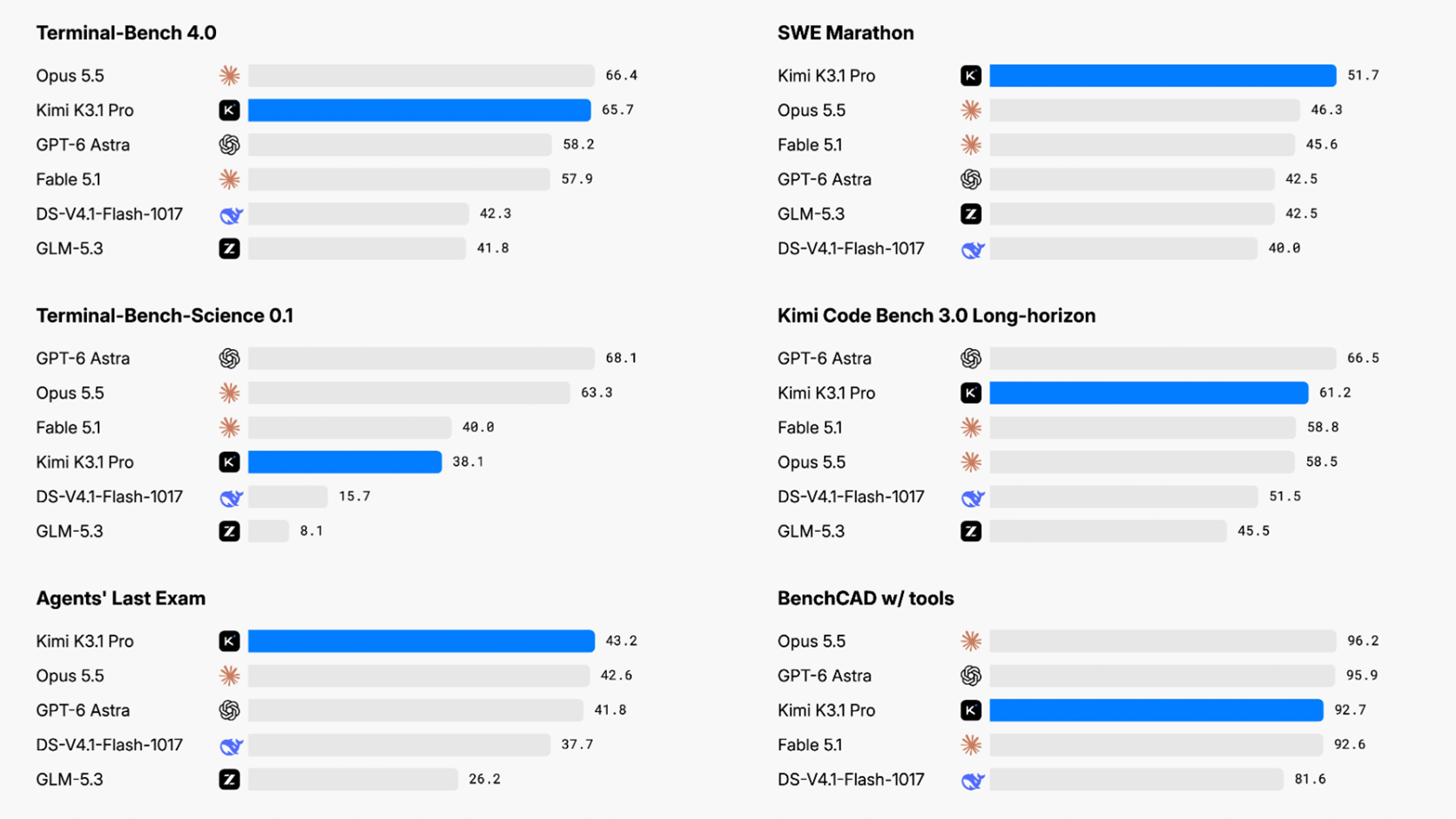
📶 Kimi K3.1 Pro - Moonshot’s new AI model, open-weights coming soon
📱 App Studio - Runway’s no-code builder for custom image and video apps
*Sponsored Listing
Anthropic is facing a $41M lawsuit from Authentic Brands Group, which controls Elvis Presley’s catalog, over claims Claude trained on 274 of his songs.
Cathedral, a startup from ex-Department of Government Efficiency staffers, said its AI agents were able to reach parts of Anthropic’s internal systems within just 12 hours.
Cohere said that Alibaba’s Qwen3.8-Flash-Next tried to upload a file to a Beijing server during a sandboxed test, raising concerns around vulnerabilities in open-weight models.
Elon Musk predicted “guppy-level death” for the 200+ neoclouds (GPU rental startups), many of which have seen massive stock surges during the AI boom, saying lenders are starting to shut out data center firms without other revenue.
Meta is selling ~$35B in new stock to bankroll its $135-145B AI infrastructure budget for 2026, with its chip suppliers Nvidia, AMD, and Broadcom eyeing up to $5B of the shares.
Read our last AI newsletter: Kimi continues to challenge the frontier
Read our last Tech newsletter: Palmer Luckey’s gene-edited war dogs
Read our last Robotics newsletter: When 110 humanoids hit the dance floor
Today’s AI tool guide: Turn sales call notes into follow-up emails with AI
RSVP to next workshop on Oct. 28: Get consultant-grade deep research back
That's it for today!Before you go we’d love to know what you thought of today's newsletter to help us improve The Rundown experience for you. |
|
See you soon,
Rowan, Zach, Shubham, Jennifer, and Nate — the humans behind The Rundown